Atlas of the external diseases of the eye : including a brief treatise on the pathology and treatment / by O. Haab ; Authorized translation from the German, edited by G.E. de Schweinitz.
- Haab O. (Otto), 1850-1931.
- Date:
- 1899
Licence: Public Domain Mark
Credit: Atlas of the external diseases of the eye : including a brief treatise on the pathology and treatment / by O. Haab ; Authorized translation from the German, edited by G.E. de Schweinitz. Source: Wellcome Collection.
Provider: This material has been provided by the Royal College of Physicians of Edinburgh. The original may be consulted at the Royal College of Physicians of Edinburgh.
141/312 (page 117)
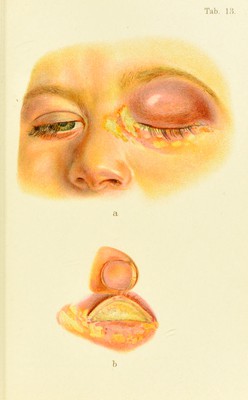
![day, for tlio first few days, and the eye tlioroiighly in- spected. [Buller’s shield, or a watch-crystal fastened over the sound eye witli strips of ^auzc and collodion, is a more easily managed dressing and permits ready inspection of the eye.—Ed.] In infants the application of such a shield is not practicable, nor is it often necessary, as both eyes are usually affected from the beginiiiug. Treatment.—DuViug the entire course of a gonorrheal conjunctivitis the first duty of the attendant is to keej) the conjunctival sac absolutely clean by constant removal of the discharge. To reduce the swelling and inflamma- tion ice-cold compresses are applied at short intervals, the eye being carefully wiped with a pledget of cotton every time the compress is changed. The conijiresses must be washed in a 1 per cent, solution of potassium perman- ganate before they are put back on the ice, and the same solution should be used by the surgeon in cleansing the eye at each examination. In the begijuiing, while the in- flammation is at its height, cold (iompresses should be applied day and night; later, the cleansing process at least must be kept up during the entire night. If the secretion is very abundant, the attendant should separate the lids every quarter of an hour, so as to allow the pus to run off; but in no case is he to wipe the conjunctival sac. That duty must be performed by the surgeon himself, from one to three times a day or oftener, as the severity of the process demands. [As collyria in ])urulent ophthalmia the Editor prefers a saturated boric-acid solution, or mer- curic chlorid, 1 : 8000, or formaldehyd, 1 ; 6000. He has also had excellent results with potassium-permanganate .solution (1 : 2000) u.sed in copious irrigations—I liter at a time. Va.seliu rubbed on the lids and introduced into the conjunctival .sac is of great advantage. Recently, protargol and argonin have been advocated in place of silver nitrate in ])urulent ophthalmia. They may be u.sed in from 2 to 5 per cent, solutions. Silver nitrate is the best remedy for checking the secre- tion. As a strong caustic solution would endanger the](https://iiif.wellcomecollection.org/image/b21691587_0141.jp2/full/800%2C/0/default.jpg)