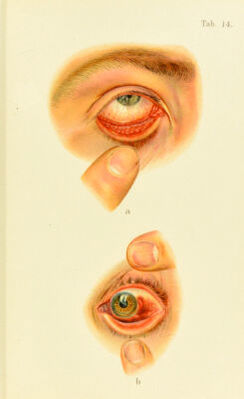
Atlas of the external diseases of the eye : including a brief treatise on the pathology and treatment / by O. Haab ; Authorized translation from the German, edited by G.E. de Schweinitz.
- Haab O. (Otto), 1850-1931.
- Date:
- 1899
Licence: Public Domain Mark
Credit: Atlas of the external diseases of the eye : including a brief treatise on the pathology and treatment / by O. Haab ; Authorized translation from the German, edited by G.E. de Schweinitz. Source: Wellcome Collection.
Provider: This material has been provided by the Royal College of Physicians of Edinburgh. The original may be consulted at the Royal College of Physicians of Edinburgh.
145/312 (page 119)
![from iulliereiit particles of secretion before silver nitrate is applied. In adnlts it is advisable in severe eases to divide the outer eantliiis by a horizontal incision vitb scissors. It facilitates eversion of the lid, allows the conjunctival sac to be cleansed more readily, and relieves the pressure ou the bulb which is so dangerous to the cornea. 4. Diphtheritic Conjunctivitis. This disease, whieh is caused by the Loffler bacillus, ])roduces alterations of varying degrees and clinical ap- pcai’ances. In one case the tliphtheritic symptoms are most conspicuous—intense inflammation, swelling of the lids, deep infiltration of the conjunctiva (Plate 13, 6), pro- ducing a grayish-yellow discoloration and followed by partial necrosis. Another case may simulate the crovjxms form of inflammation : the exudation is superficial and leads to the formation of a grayish-white or yellowish, fibrinous membrane containing fcM' cellidar elements, which is detached with more or less difficulty and reaji- jiears again and again for .several days, without inflicting any more serious injury on the mucous membrane than a slight bleeding. The false membrane usually does not extend over the bulbar conjunctiva. The clinical picture in both the croupous and the diphtheritic forms varies widely according to the extent and intensity of the process. In severe diphtheritic conjunctivitis the infiltration in- volves the bulbar conjunctiva and may threaten the cornea ; the danger to vision in such cases is very great, total blindne.ss often resulting from sloughing of the cornea. Sometimes the skin of the adjacent area shows diphtheritic synijitoms (Plate 13), the neighboring lymjfli-glands are swollen, and there is general prostration with fever. The necrosis may be .so extensive that the conjunctiva looks like a piece of yellow rubber. In the cour.se of ten to fourteen days the diphtheritic inflammation undergoes](https://iiif.wellcomecollection.org/image/b21691587_0145.jp2/full/800%2C/0/default.jpg)