Atlas of the external diseases of the eye : including a brief treatise on the pathology and treatment / by O. Haab ; Authorized translation from the German, edited by G.E. de Schweinitz.
- Haab O. (Otto), 1850-1931.
- Date:
- 1899
Licence: Public Domain Mark
Credit: Atlas of the external diseases of the eye : including a brief treatise on the pathology and treatment / by O. Haab ; Authorized translation from the German, edited by G.E. de Schweinitz. Source: Wellcome Collection.
Provider: This material has been provided by the Royal College of Physicians of Edinburgh. The original may be consulted at the Royal College of Physicians of Edinburgh.
179/312 (page 143)
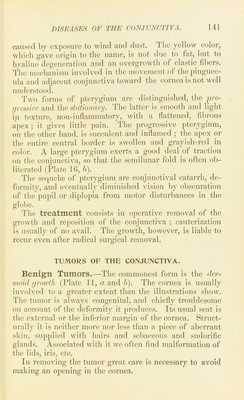
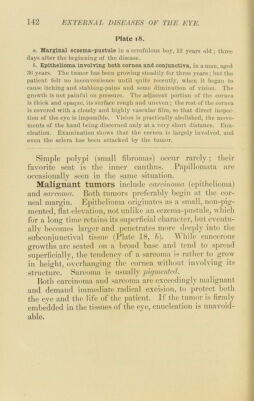
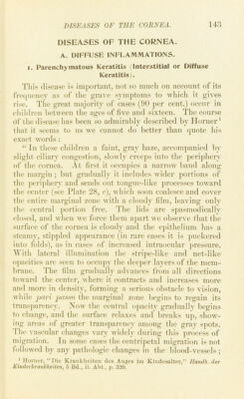
![DISEASES OF THE CORNEA. A. DIFFUSE INFLAMMATIONS. I. Parenchymatous Keratitis (Interstitial or Diffuse Keratitis). This disease is important, not so much on account of its fVc([uency as of the grave symptoms to which it gives rise. The great majority of cases (90 per cent.) occur in children between the ages of five and sixteen. The cour.se ()f the disease has been so admirably described by Horner^ that it seems to us we cannot do better than quote liis exact words : ‘^In these children a faint, gray haze, accompanied by slight ciliary congestion, slowly creeps into the periphery of the cornea. At first it occupies a narrow band along the margin ; but gradually it includes wider portions of the periphery and sends out tougue-like ])i’oce.s.ses toAvard the center (see Plate 28, c), which soon coale.sce and cover the entire marginal zone with a cloudy film, leaving oidy the central ])ortion free. The lids are spasmodically closed, and when we force them apart we ob.serve that the surface of the cornea is cloudy and the e])ithelium has a steamy, stippled appearance (in rare cases it is puckered into folds), as in cases of incrca.sed intraocular pres.sure. With lateral illumination the stripe-like and net-like opacities arc seen to occujw the dee])er layers of the mem- brane. The film gradually advances from all directions toward the center, where it contracts and increases more and more in density, forming a serious ob.stacle to vision, while pari the marginal zone begins to regain its transparency. Now the central opacity gradually begins to change, and the surface relaxes and breaks ujq show- ing areas of greater transjiarcncy among the gray sjiots. The vascular changes vary widely during this proce.ss of migration. In some cases the centripetal migration is not followed by any pathologic changes in the blood-ve.ssels; ' Horner, “Die Krankheiten des Auges im Kindesalter,” Handb. der Kinderkrankheiten, 5 Bd., ii. Abt., p. 320.](https://iiif.wellcomecollection.org/image/b21691587_0179.jp2/full/800%2C/0/default.jpg)