Atlas of the external diseases of the eye : including a brief treatise on the pathology and treatment / by O. Haab ; Authorized translation from the German, edited by G.E. de Schweinitz.
- Haab O. (Otto), 1850-1931.
- Date:
- 1899
Licence: Public Domain Mark
Credit: Atlas of the external diseases of the eye : including a brief treatise on the pathology and treatment / by O. Haab ; Authorized translation from the German, edited by G.E. de Schweinitz. Source: Wellcome Collection.
Provider: This material has been provided by the Royal College of Physicians of Edinburgh. The original may be consulted at the Royal College of Physicians of Edinburgh.
183/312 (page 145)
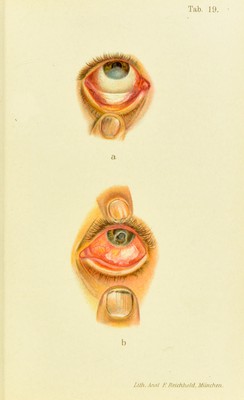
![usuallv present themselves lor treatment until after the eentrij)etal migration is eompleted. “ When iritis oceiirs as a eomplieation the preeipitates on the ])osterior lamina of the eornea and the seeondaiy changes in the more anterior portions of the membrane tcml to accentuate the punctate api)earanee of the opacity and thus form another source of error. In about 30 per cent, of all cases of interstitial keratitis the deep struct- urt!S of the eve become involved early in the course of the disease; but in most eases this complication a])pears hiueh later. Iritis nsnally takes the serous form ; it is attended with the deposition of heavy precipitates on the posterior lamina of the eornea and ligamentum pectina- tum, slight exudation into the pupil, and variable pressure- svmj)toms—usually subnormal tension. As serous iritis itself is a form of luieitis, we are often able, after the cen- ter of the cornea has cleared uj), to e.stablish the exist- ence of oj)acities in the vitreous, equatorial foci of cho- roiditis, and uveal neuritis; we may find polar and poste-' rior cortical cataract—in short, all the signs of a diffuse morbid process, which from its conspicuous feature has been called diffuse keratitis, but is very often a panoph- thalmia. ‘‘The disease usually affects both eyes, the second being attacked days, weeks, or even months after its fellow. I myself have been able to establish bilateral involvement in 80 per cent, of my cases, in sjfite of the obvious fact that the patient hails the appearance of disease in the sec- ond eye as a proof of inefficient treatment and seeks ad- vice elsewhere. It is always advisable to predict the probable occurrence of the disorder in the other eye, and to warn the patient that it is very apt to run a sIoav and tedious course. The most favorable cases last from six to eight weeks; secondary opacities, iritie complications,and their consequences protract the duration of the disease to months and years. lielapses are frequent, even after long intervals of freedom from the disease. These relapses do not, as a rule, exhibit the same character as the original 10](https://iiif.wellcomecollection.org/image/b21691587_0183.jp2/full/800%2C/0/default.jpg)