Atlas of the external diseases of the eye : including a brief treatise on the pathology and treatment / by O. Haab ; Authorized translation from the German, edited by G.E. de Schweinitz.
- Haab O. (Otto), 1850-1931.
- Date:
- 1899
Licence: Public Domain Mark
Credit: Atlas of the external diseases of the eye : including a brief treatise on the pathology and treatment / by O. Haab ; Authorized translation from the German, edited by G.E. de Schweinitz. Source: Wellcome Collection.
Provider: This material has been provided by the Royal College of Physicians of Edinburgh. The original may be consulted at the Royal College of Physicians of Edinburgh.
201/312 (page 155)
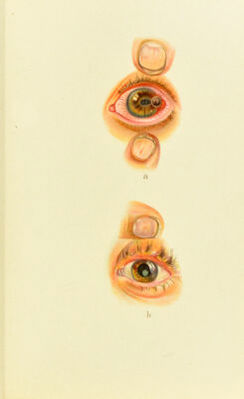
![tropliicd tiirbinals, adenoid vegetations, etc. The lacliry- inonasal duct shonld be ke[)t patidons. Severe corneal ulcers are managed on general princijdes.—Ed.] 3, Herpes Corner. Herj)es is another form of keratitis of a dermoid ehar- acter and occurs as herpes zostei’ or as herpes febrilis. Herpes zoster (see p. 92) produces various lesions in the cornea : 1. The vesicnlar eruption may appear jn-imarily in the cornea at the same time as on tlie skin (Idatc 20). The vesicles appear in groups, raj)idly break down, and form an irregnlar, shallow nicer, which sometimes becomes deeper and gives rise to extensive j)nrnlent infiltration of the cornea. In the mildest cases the site of the vesic- ular ern])tion is marked by a more or less })crmanent opacity (Plate 20). Iritis occurs in some instances as a com])lication. The most eonspicnons symptom in this and in the following forms of herpes zoster is lessen- ing or abolition of the sensibility, which is determined by touching the eye with a twist of cotton. 2. In some cases anesthesia occurs in circiunscribed areas, and upon careful examination delicate nebidie, often composed of numerous, small round dots, are seen in these areas and sometimes produce shallow ulcers, but in most cnses persist for some time without breaking down and eventually disappear entirely. These o])aqne spots a])pear to be directly dependent nj)on the anesthesia or disease of the trifacial, which is the original cause of herpes. 3. Paralysis of the trifacial may give rise to neuro- paralytic kei'atifi.s, a dangerous form of inflammation caused by pyogenic micrococci, which may lead to exten- sive ulceration or purulent (colliquative) necrosis of the corneal tissues. The treatment of herpes zoster consists in the careful and continued application of a protective (sealed) band- age, which, if persevered in, may possibly ward off neuro- paralytic keratitis. For this reason it should be employed \](https://iiif.wellcomecollection.org/image/b21691587_0201.jp2/full/800%2C/0/default.jpg)