Atlas of the external diseases of the eye : including a brief treatise on the pathology and treatment / by O. Haab ; Authorized translation from the German, edited by G.E. de Schweinitz.
- Haab O. (Otto), 1850-1931.
- Date:
- 1899
Licence: Public Domain Mark
Credit: Atlas of the external diseases of the eye : including a brief treatise on the pathology and treatment / by O. Haab ; Authorized translation from the German, edited by G.E. de Schweinitz. Source: Wellcome Collection.
Provider: This material has been provided by the Royal College of Physicians of Edinburgh. The original may be consulted at the Royal College of Physicians of Edinburgh.
205/312 (page 157)
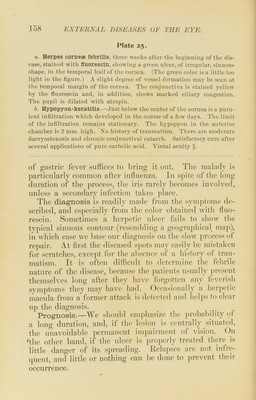
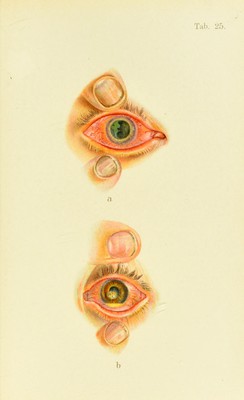
![diagnostic value in doubtful eases. [As pointed out by Veasey, toluidiu-blue will also stain the cornea when it is deprived of epitlielinin.—Ed.] Before the stain is intro- diused, a few drops of a 2 ]>er cent, solution of eoc^ain are instilled into the eye, which has the incidental advantage of intensifying the color. One dro}> ot an alkaline solu- tion of fluorescin (flnorescin, 0.2 ; sod. earb., 0.3 ; aqua destill., 10.0) is then applied to the eornea and the eye kept closed for half a minute, after which it is thoroughly washed with a 1 : 5000 bichlorid solution. The peculiar shape of the ulcer at once becotoes manifest (Plates 24 and 2,5, a). Occasionally more than one nicer is to be seen. As a rule, the original outline is retained throughout the (;onrsc of the disease ; in exceptional cases, however, small extensions make their appearance after a few days, due to deeper-lying ulcers whose epithelial covering has just separated. Of course, if secondary infection and infiltra- tion of the surrounding tissue supervene, the ulcer may assume any size, and may even result in a true hypopyon. The distinguishing feature of herpetic ulcer is the exceed- ingly slow healing ])rocess, requiring from four to eight weeks for its completion, which is probably due to the scant and sluggish vessel-formation. The explanation may be found in the fact that the nerves are diseased in herjies febrilis as well as in herpes zoster; this is shown by the diminished sensibility of the eornea observed in many cases. As in all forms of corneal ulcer, regeneration begins at the edges; a new epithelial covering overspreads the floor of the ulcer, so that it recov- ers its reflecting power and does not stain with flnorescin. The original level is very gradually restored, although a more or less pronounced macula always remains and for years afterward retains the shape of the original ulcer (Plate 24). Herj)es cornefe does not aj)j)ear in successive crops, like eczema ; but it is prone to recur in the same eye, or, by way of variety, in the other eye, whenever the individual happens to have fever. An ordinary cold or a short attack](https://iiif.wellcomecollection.org/image/b21691587_0205.jp2/full/800%2C/0/default.jpg)