Atlas of the external diseases of the eye : including a brief treatise on the pathology and treatment / by O. Haab ; Authorized translation from the German, edited by G.E. de Schweinitz.
- Haab O. (Otto), 1850-1931.
- Date:
- 1899
Licence: Public Domain Mark
Credit: Atlas of the external diseases of the eye : including a brief treatise on the pathology and treatment / by O. Haab ; Authorized translation from the German, edited by G.E. de Schweinitz. Source: Wellcome Collection.
Provider: This material has been provided by the Royal College of Physicians of Edinburgh. The original may be consulted at the Royal College of Physicians of Edinburgh.
210/312 (page 160)
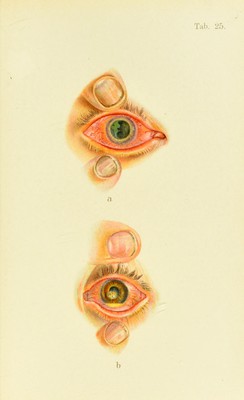
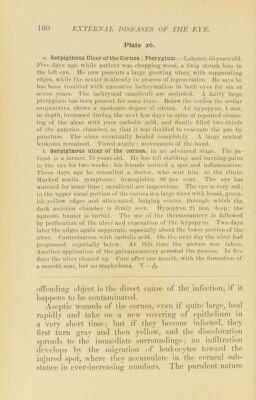
![Plate 26. a. Serpiginous Ulcer of the Cornea ; Pterygium.—L:i))oror, (i5 years old. Five days ago, while patient was chopping wood, a twig .struck him in the left eye. He now presents a large growing ulcer, with suppurating edges, while the center is already in process of regeneration. He says he has been troubled with excessive lachryination in both eyes for six or seven years. 'I'lie lachrymal canaliculi are occluded. A fairly large pterygium has been present for some time. Below the cornea the ocular conjunctiva shows a moderate degree of edema. An hypopyon, 1 mm. in depth, increased during the next few days in spite of repeated cleans- ing of the ulcer with ]ture carbolic acid, and tinally filled two-thirds of the anterior chamber, so that it was decided to evacuate the pus by puncture. The ulcer eventually healed completely. A large central leukoma remained. Visual acuity: movements of the hand. h. Serpiginous ulcer of the cornea, in an advanced stage. The pa- tient is a farmer, 75 years old. He has felt stabbing- and burning-pains in the eye for two weeks; his friends noticed a spot and inflammation, 'rhree days ago he consulted a doctor, who sent him to the clinic. .Marked senile, symptoms; hemoglobin, 80 per cent. The eye has watered for some time; canaliculi are impervious. The eye is very red; in the upper nasal imrtion of the cornea is a large nicer with broad, green- ish-yellow edges and attenuated, bulging center, through which the dark anterior chamber is dimly seen. Hy])o])yon 21 mm. deep; the aqueous humor is turbid. The use of the thermocautery is followed by ])erforation of the ulcer and evacuation (»f the hypopyon. Two days later the edges again sui)purate, especially about the lower |)ortion of the ulcer. Cauterization with carbolic acid. On the next day the ulcer had ])rogressed, especially below. At this time the picture was taken. Another application of the galvanocautery arrestesl the process. In five days the ulcer cleared up. Cure after one month, with the formation of a smooth scar, hut 110 staphyloma. V — offending object is tlie direct cause of the infection, if it ha])])cns to be contaminated. Aseptic wounds of the cornea, even if ([iiite large, heal rajiidly and take on a new (iovering of epithelium in a very .short time; but if they become infected, they first turn gray and then yellow, and the discoloration sjtreads to the immediate surroundings; an infiltration develops by the migration of lenkocytes toward the injured spot, ivhere tiiev accumulate in the corneal sub- stance in ever-increasing numbers. The purulent nature](https://iiif.wellcomecollection.org/image/b21691587_0210.jp2/full/800%2C/0/default.jpg)