Atlas of the external diseases of the eye : including a brief treatise on the pathology and treatment / by O. Haab ; Authorized translation from the German, edited by G.E. de Schweinitz.
- Haab O. (Otto), 1850-1931.
- Date:
- 1899
Licence: Public Domain Mark
Credit: Atlas of the external diseases of the eye : including a brief treatise on the pathology and treatment / by O. Haab ; Authorized translation from the German, edited by G.E. de Schweinitz. Source: Wellcome Collection.
Provider: This material has been provided by the Royal College of Physicians of Edinburgh. The original may be consulted at the Royal College of Physicians of Edinburgh.
214/312 (page 162)
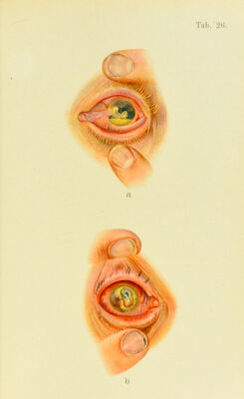
![Plate 27. Suppuration of the Cornea from Serpiginous Ulcer; Panophthalmitis. —The patient, who is 73 years old and a farmer by occupation, wa.s treated in this clinic a year ago for conjunctival catarrh, which is now present, as may be seen by tlic dried secretion at the inner canthus of the left eye. The tear-duct is patulous on both sides. Four days ago the patient noticed a burning sensation in the right eye, but paid no at- tention to it until yesterday, when he found that he could not see clearly. He does not know of any injury. In the right eye the lids are glued fast with secretion, the conjunctiva is red and swollen, and there is ciliary congestion ; the cornea is clear except at the center, which is oc- cupied by a circular, shallow ulcer, 2 mm. in diameter, not serpiginous, but of a uuiibrm greenish or yellow color. Small hypopyon. Behind and a little below the ulcer in tlie anterior cliamber a strip of purulent exudate is adherent to tlie cornea. Aqueous humor turbid. The ulcer was immediately incised after the method of Saemiscli. The exudate behind the ulcer was e.xtracted, and brought with it a membrane which lined almost the entire anterior chamber. The next day the sloughing of the cornea liad increased, and the incision was opened once more. On the following day the purulent ulcer was much larger, a large amount of pus had collected in the anterior cliamber, and there was incipient panophthalmitis, with edema of the lids and copious purulent discharge from the conjunctiva (see Plate). On the fifth day after treatment was begun the entire cornea was converted into a greenish-yellow purulent infiltrate, and in the course of the next few days sloughed away more and more, while panophthalmia increased pari passit. so-called torpid ulcers of this kind, which give little pain (perhaps because the sensitive fibers are paralyzed by the toxin), blit are none the less .serious. The most frequent, as well as the most dangerous, type of hypopyon-keratitis is the serpif/inous ulcer, one of the most malignant forms of corneal disease, which is attended with great danger to the eyesight from the fact that it preferably affects the central jiortions of the cornea. The nicer spreads rapidly by one or more of its margins ad- vancinif in the form of an elevated curve of vellow infil- tration (see Plate 26), while the ])arts of the nicer lying behind this propagating arc, as it is called, show more or less tendency to repair. Hypopyon .soon develops. Left to itself, the lesion at first procluces exten.sive destruction](https://iiif.wellcomecollection.org/image/b21691587_0214.jp2/full/800%2C/0/default.jpg)