Atlas of the external diseases of the eye : including a brief treatise on the pathology and treatment / by O. Haab ; Authorized translation from the German, edited by G.E. de Schweinitz.
- Haab O. (Otto), 1850-1931.
- Date:
- 1899
Licence: Public Domain Mark
Credit: Atlas of the external diseases of the eye : including a brief treatise on the pathology and treatment / by O. Haab ; Authorized translation from the German, edited by G.E. de Schweinitz. Source: Wellcome Collection.
Provider: This material has been provided by the Royal College of Physicians of Edinburgh. The original may be consulted at the Royal College of Physicians of Edinburgh.
231/312 (page 173)
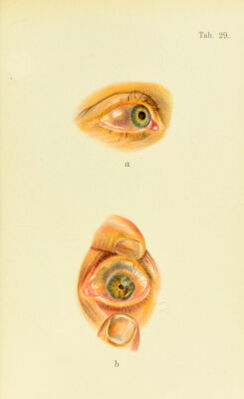
![tuberculous or the subjects of hereditary or acquired syphilis. The disease, which usually lasts for years, is rarely amenable to treatment. Episcleritis \s more common than the deep form, and is characterized by the scleritic hump (Plate 29, a) which betrays its site by a deep, bluish-red injection underneath, which is not movable with the conjunctiva. The inflamma- tory foci never ulcci’ate, but gradually disaj^pear in from five to ten weeks or later, leaving a dull gray spot due to the attenuation of the scleral tissue. Episcleritis is also refractory to treatment, especially the migrating form, which tends to encircle the cornea wholly or partially— scleritis migrans. The elevations in the sclera, which represent a true round-cell infiltration, vary in size from 3 to 8 mm. ; several may be present in the same eye. They are usually very sensitive to pressure, but not painful if undisturbed, except in a few cases, when the pain is said to be very dis- tressing. The process is very apt to recur, and, in course of time, attacks both eyes. Episcleritis is, on the whole, less dangerous than the deep form, and is followed by fewer complications. Tuberculosis and syphilis are predisposing causes; but the affection is more often observed in connection with the rheumatic diathesis, and the treatment in most cases should consist of active antirheumatic remedies: sweating and a long-continued use of sodium salicylate. 2. Injuries of the Sclera. In addition to stab- and cut-wounds, which are quite common, we occasionally see the more serious injury of rupture of the sclera, caused by the a])])lication of violent external force—a bloAv with the fist or a stick, or a cow’s horn, or collision with any blunt object. Rupture of the sch'ra is, of course, a perforating wound, and therefore endangers the contents of the globe; the same is true, however, of most stab- and cut-wounds. Besides causing](https://iiif.wellcomecollection.org/image/b21691587_0231.jp2/full/800%2C/0/default.jpg)