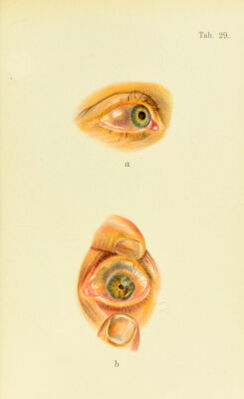
Atlas of the external diseases of the eye : including a brief treatise on the pathology and treatment / by O. Haab ; Authorized translation from the German, edited by G.E. de Schweinitz.
- Haab O. (Otto), 1850-1931.
- Date:
- 1899
Licence: Public Domain Mark
Credit: Atlas of the external diseases of the eye : including a brief treatise on the pathology and treatment / by O. Haab ; Authorized translation from the German, edited by G.E. de Schweinitz. Source: Wellcome Collection.
Provider: This material has been provided by the Royal College of Physicians of Edinburgh. The original may be consulted at the Royal College of Physicians of Edinburgh.
233/312 (page 175)
![(liiction in the tension of the globe. The ophthalinoseope .sliows more or less hemorrhage and inflammatory turbidity in the vitreous body. If the wound is situated along the equator, a bright band may be seen in the ophthalmoscopic image, indicating a lesion of the choroid. The presence of a foreign body in the interior of the globe demands a thorough ophthalmoscopic examination. If the suspected substance is iron, it is advisable to use the sideroscope, a very delicate magnetic needle provided with a device which jiermits its deviations to be read off with a tele- scope, or the large electromagnet, ])roj)Osed by me, which either attracts the splinter toward the iris or at least indi- cates the presence of iron by the pain it produces. [The R()utgen rays furnish a means by which the pre.sence and position of a foreign body in the eye can be determined with accuracy. Of the many methods suggested for em- ploying the A'-rays under these circumstances, that one proposed by W. M. Sweet seems to the Editor, who speaks from experience, to be the best.] Xever explore a wound in the sclera irith a j)robe, either for the purpose of detecting a suspected foreign body or to determine whether the wound is really a per- forating one. For in doing so there js great danger of in- troducing pathogenic germs, which may be jjresent on the exterior of the wound, into the vitreous body and setting up a fatal inflammatory process in the interior of the globe. The treatment of scleral wounds demands absolute rest in bed, at least for some time. If the wound is large, both eyes must be bandaged. If the wound is already closed, it is better not to disturb it; gaping wounds may be care- fully closed with sutures passing through the conjunctiva and e])iscleral tissue ; it is not usually advisable to in- clude the sclera itself in the sutures. Oidy when the piece of iron which has penetrated the .sclera is very large should the attempt be made to extract it through the .scleral wound with an electromagnet; small splinters should be drawn into the anterior chamber and](https://iiif.wellcomecollection.org/image/b21691587_0233.jp2/full/800%2C/0/default.jpg)