Atlas of the external diseases of the eye : including a brief treatise on the pathology and treatment / by O. Haab ; Authorized translation from the German, edited by G.E. de Schweinitz.
- Haab O. (Otto), 1850-1931.
- Date:
- 1899
Licence: Public Domain Mark
Credit: Atlas of the external diseases of the eye : including a brief treatise on the pathology and treatment / by O. Haab ; Authorized translation from the German, edited by G.E. de Schweinitz. Source: Wellcome Collection.
Provider: This material has been provided by the Royal College of Physicians of Edinburgh. The original may be consulted at the Royal College of Physicians of Edinburgh.
238/312 (page 178)
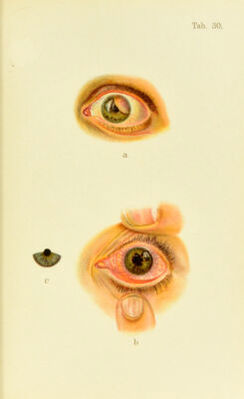
![])rojectioiis of varying 'widtli (Plate 30, h) and mar the cireular outline of tlie pu])il. These attachments are called posterior si/nechicr, to distinguish them from anterior synechiae between the iris and the cornea, M'hicli occur in perforations of the cornea. If the ease is seen late, the entire ]mpillary margin may be bound down and the pupil may fail to dilate altogether under the infinence of a myd- riatic. Sometimes the pnj)il begins to dilate at various points after a long application of the drug, by the freshly formed synechite giving way, and if the attachments are not too old it is sometimes possible to loosen them all in this way and restore the contour of the pupil. The at- tachment of the whole j)n])illary margin by an annular .synechia is termed c.rc/a.v/oa of the pupil (f>cc\us\o ])upill{e), becau.se the space behind the iris, the po.sterior chamber, is excluded from the anterior chamber. If numerous synechise are formed, they are usually a.sso- ciated with exudation into the pupillary region and the formation of a false membrane which comj)letely occludes the pupil; this is called occlusion of the pupil (occlusio jnipilke). The interference with vision is directly propor- tional to the thickness of the membrane. At the .same time a similar exudation takes ])lace in the aqueous humor, which becomes turbid with leukocytes and fibrin, and leads to still greater obscuration of the iris and pupil. In severe ijrades the leukoevtes mav collect at the bottom of the anterior ehamber, forming a hypojtyou and thus in- dicating the pundent nature of the iritis. In other cases the exudate consi.sts ])riucij)ally of fibrin and forms a semitrans])arent grayish ojiacity in the anterior chamber. High grades of iritis usually give ri.^^e to a diffuse hazi- ness of the cornea, due partly to fine deposits on its pos- terior surface, and ])artly to direct ])articipation in the in- flammatory proce.'^s in the form of an infiltration of migra- tory leukoewtes. The ])ain in .severe iritis is often very great, and s])reads from the eye to the brow and teni])le ; it becomes almost unbearable if’ the eye is exposed to the light; but may](https://iiif.wellcomecollection.org/image/b21691587_0238.jp2/full/800%2C/0/default.jpg)