Atlas of the external diseases of the eye : including a brief treatise on the pathology and treatment / by O. Haab ; Authorized translation from the German, edited by G.E. de Schweinitz.
- Haab O. (Otto), 1850-1931.
- Date:
- 1899
Licence: Public Domain Mark
Credit: Atlas of the external diseases of the eye : including a brief treatise on the pathology and treatment / by O. Haab ; Authorized translation from the German, edited by G.E. de Schweinitz. Source: Wellcome Collection.
Provider: This material has been provided by the Royal College of Physicians of Edinburgh. The original may be consulted at the Royal College of Physicians of Edinburgh.
255/312 (page 191)
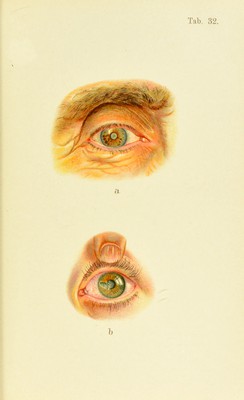
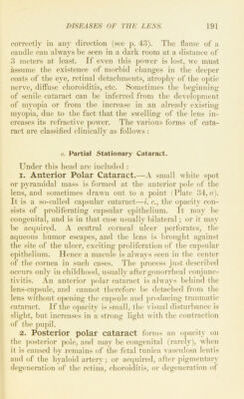
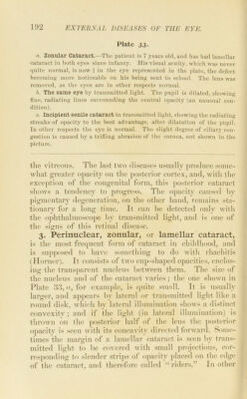
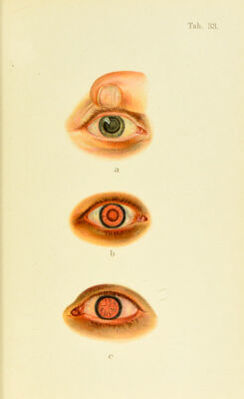
![correctly in any direction (see p. 43). Tlie tianie of a candle can always be seen in a dark room at a distance of 3 meters at least. If even this power is lost, we must ^issnme the existence of morbid changes in the deeper coats of the eye, retinal detachments, atrophy of the o])tic nerve, diffuse choroiditis, etc. Sometimes the beginning of senile cataract can be inferred from the devclojnnent of myopia or from the increase in an already existing myopia, due to the fact that the swelling of the lens in- creases its refractive power. The various forms of cata- ract are classified clinically as follows : «. Partial Stationary Cataract. Under this head are included : 1. Anterior Polar Cataract.—A small white spot or pyramidal mass is formed at the anterior pole of the lens, and sometimes drawn out to a point (Plate 34, o). It is a so-called capsular cataract—i. e., the opacity con- sists of proliferating capsular epithelium. It may be congenital, and is in that case usually bilateral; or it may be acquired. A central corneal ulcer perforates, the aqueous humor escapes, and the lens is brought against the site of the ulcer, exciting proliferation of the caj)sular epithelium. Hence a macule is always seen in the center of the cornea in such cases. The process just described occurs only in childhood, usually after gonorrheal conjunc- tivitis. An anterior polar cataract is always behind the lens-capsule, and cannot therefore be detached from the lens without opening the capsule and ])r()dueing traumatic cataract. If the opacity is small, the visual disturbance is slight, but increases in a strong light with the contraction of the pupil. 2. Posterior polar cataract forms an opacity on the posterior pole, and may be congenital (rarely), when it is caused by remains of the fetal tunica vascnlosa lentis and of the hyaloid artery; or acquired, after pigmentary degeneration of the retina, choroiditis, or degeneration of](https://iiif.wellcomecollection.org/image/b21691587_0255.jp2/full/800%2C/0/default.jpg)