Atlas of the external diseases of the eye : including a brief treatise on the pathology and treatment / by O. Haab ; Authorized translation from the German, edited by G.E. de Schweinitz.
- Haab O. (Otto), 1850-1931.
- Date:
- 1899
Licence: Public Domain Mark
Credit: Atlas of the external diseases of the eye : including a brief treatise on the pathology and treatment / by O. Haab ; Authorized translation from the German, edited by G.E. de Schweinitz. Source: Wellcome Collection.
Provider: This material has been provided by the Royal College of Physicians of Edinburgh. The original may be consulted at the Royal College of Physicians of Edinburgh.
256/312 (page 192)
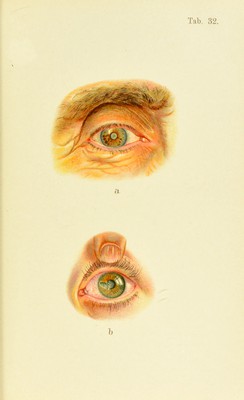
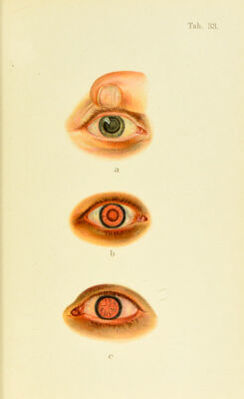
![Plate 33. n. Zonular Cataract.—The patient is 7 years old, and has had lamellar cataract in both eyes since infancy. His visual acuity, which was never quite normal, is now i in the eye represented in the plate, the defect becoming more lioticeable on his being sent to scliool. The lens was removed, as the eyes are in other respects normal. ft. The same eye by transmitted light. The pupil is dilated, showing fine, radiating lines surrounding the central opacity (an unusual con- dition). c. Incipient senile cataract in transmitted light, showing the radiating .streaks of opacity to the best advantage, after dilatation of the pupil. In other respects the eye is normal. The slight degree of ciliary con- gestion is caused by a trifling abrasion of the cornea, not shown in the picture. the vitreou.s. The la.st two tliseascis u.sually produce .'Some- what greater ojiataty on the po.sterior cortex, and, witli the exception of the congenital form, thi.s po.sterior cataract .sliows a tendency to jirogrc.s.s. The opacity caused l)v pigmentary degeneration, on the other hand, remain.s .sta- tionary for a lonp; time. It can be detected oidv with the ophthalmo.scope by transmitted light, and is one of the signs of this retinal disease. 3. Perinuclear, ^jonular, or lamellar cataract, is the most frequent form of eataract in childhood, and is snp])oscd to have something to do with rhachitis (Horner). It consists of two enp-shaped opacities, enclos- ing the transparent nnclens between them. The size of the nnclens and of the cataracT varies; the one shown in Plate 33, o, for example, is (piite smell. It is nsnally larger, and ajipears by lateral or transmitted light like a round disk, which by lateral ilhnnination shows a distinct convexity; and if the light (in lateral illumination) is thrown on the po.sterior half of the lens the ])o.sterior opacity is seen with its concavity directed forward. Some- times the margin of a lamellar cataract is seen by trans- mitted light to be covered with small projections, cor- responding to slender .strips of opacity ])laced on the edge of the cataract, and therefore called “ riders.’’ In other](https://iiif.wellcomecollection.org/image/b21691587_0256.jp2/full/800%2C/0/default.jpg)