Atlas of the external diseases of the eye : including a brief treatise on the pathology and treatment / by O. Haab ; Authorized translation from the German, edited by G.E. de Schweinitz.
- Haab O. (Otto), 1850-1931.
- Date:
- 1899
Licence: Public Domain Mark
Credit: Atlas of the external diseases of the eye : including a brief treatise on the pathology and treatment / by O. Haab ; Authorized translation from the German, edited by G.E. de Schweinitz. Source: Wellcome Collection.
Provider: This material has been provided by the Royal College of Physicians of Edinburgh. The original may be consulted at the Royal College of Physicians of Edinburgh.
263/312 (page 195)
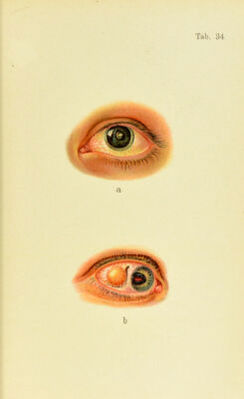
![diminishes, the anterior chamber becomes al)normally deep, and an anterior ca])sular cataract not infrequently appears in the sliape of small white dots. Shining choles- terin-crystals are seen suspended in the liquefied cataract. xVs the cataract continues to shrink, it becomes tremulous, and, finally, the zonula may give way and produce luxa- tion of the cataract. 2. Congenital cataract is much less frequent than the senile form ; it is usually bilateral and soft, a-s there is no nucleus. In very exceptional cases congenital total cataract is hard, for reasons that are not understood as yet. 3. Traumatic Cataract.—This is nearly always progressive. Any laceration of the lens-capsule, which admits the aqueous humor or vitreous body to the sub- stance of the lens, is followed by cataract. The injury may be direct, caused by some perforating instrument (knife, scissors, foreign body, etc.) ; or indirect, from con- tusion of the entire globe, the caj)sule probably becoming ruptured at the equator. In rare instances cataract may be ]n*oduced by mere concussion of the lens without solu- tion of continuity in the capsular structures. In large wounds of the anterior capsule the greater part of the lens may become turbid within twenty-four liours; iu smaller wounds the cataract develops more gradually. A grayish or bluish-white discoloration at first appears about the in- jured spot (Plate 32, h); the lens-substance swells and projects into the anterior chamber in the form of a cone. Particles of the lens-substance separate and sink to the bottom. In small wounds the swelling is inconsiderable, and absorption of the cataract in the anterior chamber, which is usually quite rapid in young people, takes ])lace more slowly in consequence. If the communication be- tween the acpieous humor and the lens is maintained, swelling and absorj)tion continue until all of the lens-sub- stance except the capsule is removed. A small rent in the capsule may In; enlarged by the swelling of the cataract; or, if it is very small, it may be closed, either by the pro- liferation of capsular epithelium or by adhesion of the iris.](https://iiif.wellcomecollection.org/image/b21691587_0263.jp2/full/800%2C/0/default.jpg)