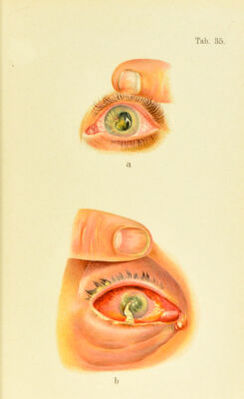
Atlas of the external diseases of the eye : including a brief treatise on the pathology and treatment / by O. Haab ; Authorized translation from the German, edited by G.E. de Schweinitz.
- Haab O. (Otto), 1850-1931.
- Date:
- 1899
Licence: Public Domain Mark
Credit: Atlas of the external diseases of the eye : including a brief treatise on the pathology and treatment / by O. Haab ; Authorized translation from the German, edited by G.E. de Schweinitz. Source: Wellcome Collection.
Provider: This material has been provided by the Royal College of Physicians of Edinburgh. The original may be consulted at the Royal College of Physicians of Edinburgh.
267/312 (page 199)
![over-ripe cataruet, and luxation may be induced by the slightest shock, a blow, or the momentary congestion ' caused by bending over or sneezing. The greater the dislocation of the lens, the greater the visual disturbance. Siibhixation gives rise to myo})ia and astigmatism, and, later, to more marked disturbances from obscuration of the lens. Complete dislocation of the lens from the pupillary area has the .same etfect on vision as absence of the lens, or aphakia, and causes a re- duction in the refractive power, which in emmetropic eyes amounts to 10 D. If the lens be(U)mes iixed in the vitre- ous body and causes no further disturbance, the patient can .see quite well with-cataract-glasses. Such cases are, however, exceptional. Usually the condition is very pain- ful and gradually leads to glaueoma and total blindness. The prognosis in dislocation of the lens is very grave. The eye is always in great danger and in many cases its I0.SS is unavoidable. Treatment.—In a very few cases the aphakia may be corrected by the use of suitable convex glasses. In par- tial dislocations, especially in young persons, the lens should be removed by di.scission ; in fresh luxations into the vitreous chamber an attempt may be made to induce fixation by rest in bed, any intercurrent rise in tension to be met by the instillation of myotics (physostigmin, ])ilo- carpin), or the glaucoma may be ehecked by repeated sclerotomy. Extraction of the lens is usually attended with a dangerous escape of vitreous humor. Glaucoma not infrequently necessitates removal of the globe. DISEASES OF THE VITREOUS BODY. Disease of the vitreous, in the large majority of cases, is secondary to inflammation of the ciliary body, choroid, and retina, and manife.sts itself in turbidity, due to the entrance of inflammatory material, and in degeneration.](https://iiif.wellcomecollection.org/image/b21691587_0267.jp2/full/800%2C/0/default.jpg)