Atlas of the external diseases of the eye : including a brief treatise on the pathology and treatment / by O. Haab ; Authorized translation from the German, edited by G.E. de Schweinitz.
- Haab O. (Otto), 1850-1931.
- Date:
- 1899
Licence: Public Domain Mark
Credit: Atlas of the external diseases of the eye : including a brief treatise on the pathology and treatment / by O. Haab ; Authorized translation from the German, edited by G.E. de Schweinitz. Source: Wellcome Collection.
Provider: This material has been provided by the Royal College of Physicians of Edinburgh. The original may be consulted at the Royal College of Physicians of Edinburgh.
279/312 (page 207)
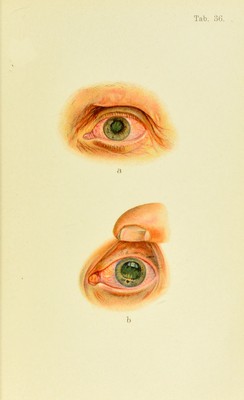
![chamber is excessively shallow; the iris reduced to a narrow ribbon or completely obliterated in places (Plate 40). The pupil is widely dilated and immovable, and shows a greenish retlex shining through. The papilla of the optic nerve is deeply excavated in its entire circumfer- ence and the eyeball is as hard as stone. From time to time the eye is (piite painful, and eventually degenerates, while the cornea becomes permanently obscured and cov- ered with glassy deposits and hypertrophied folds. The sclera may exhibit ectasia about the cornea or in the equatorial region. The lens becomes cataractous. The course of chronic inflammatory glaucoma is slower than that of the acute variety, which sometimes takes the form of fidminat'mc/ glaucoma and utterly destroys the eyesight in a few hours. h. Non-inflammatory or Simple Glaucoma.— In this treacherous form of glaucoma the visual deteriora- tion imperceptibly goes on to complete blindness without the patient’s being aware of distinct attacks or of pain and inflammation. The examining surgeon often finds one eye irremediably injured or absolutely blind, and the other more or less amblyopic; rise in tension is barely perceptible or even absent; but the optic nerve is found to be excavated. By testing the tension repeatedly at various times of the day, however, especially early in the morning, the cardinal symptom cafi usually be obtained, and on careful inquiry the patient admits that he has had slight pain and dimness of vision. The loss of vision usually begins at the circumference of the field of vision, the restriction beino: most noticeable at first on the nasal side. Central vision is also affected to a corresponding extent, although it is relatively better up to a certain period in the di.sease. The disease always affects both eyes, and may be protracted for years, eventually ])assing into the inflammatorv or tin? hemorrhagic form. In some cases of simple glatujoina the degeneration of the optic nerve is probably hastened by the abnormal loss of rigid- ity of the lamina cribrosa.](https://iiif.wellcomecollection.org/image/b21691587_0279.jp2/full/800%2C/0/default.jpg)