Atlas of the external diseases of the eye : including a brief treatise on the pathology and treatment / by O. Haab ; Authorized translation from the German, edited by G.E. de Schweinitz.
- Haab O. (Otto), 1850-1931.
- Date:
- 1899
Licence: Public Domain Mark
Credit: Atlas of the external diseases of the eye : including a brief treatise on the pathology and treatment / by O. Haab ; Authorized translation from the German, edited by G.E. de Schweinitz. Source: Wellcome Collection.
Provider: This material has been provided by the Royal College of Physicians of Edinburgh. The original may be consulted at the Royal College of Physicians of Edinburgh.
282/312 (page 210)
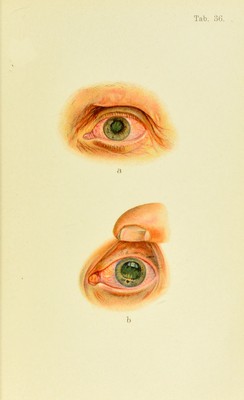
![Plate 37. Sarcoma of the choroid, which has ruptured anteriorly. The patient, who is 53 years old, says he received a severe blow on the left eye eleven years ago, by running against a beam, and that since then vision gradu- ally deteriorated and the eye sometimes gave him pain. About six mouths ago the eye began to increase in size. A large conical tumor projects through the palj)ebral fissure, and is seen to be covered with a number of smaller nodules (hidden in part under the upper lid). A small, bluish segment of the cornea is seen below. The growtli is imper- vious to sunlight even when a lens is used. In places it feels hard to the touch. No pulsation in the tumor. No glandular swelling on the left side of the head. The whole contents of the orbit were immediately extirpated and the diagnosis of .sarcoma confirmed by examination of the specimen (moderately pigmented spiudle-eell sarcoma) and by the subse- quent course, for the man died a year later of a large sarcoma involving the left half of the j)elvis and the inguinal glands on both sides, and of a sarcoma in the right deltoid mu.scle. The tumor did not recur in sHit. instilled into the eye every day. Pilocar|)in is the milder of the two, and is well adapted for long-eontinued use and after an operation. This is supplemented by subcutaneous injections of morphin, which has the double advantage of inducing sleep and a.ssisting in the jiroduction of myosis. Atropin is to be strictly avoided in glaucoma. The success of an operation for glaucoma depends alto- gether on its being performed early in the disease. Iri- dectomy is the best operation in inflammatory, and sclerot- omy in simple, glaucoma in an advanced stage. In the early stages of simjfle glaucoma iridectomy may also be employed. It is often advisable to combine the two opera- tions, and many cases require rej>eated sclerotomies at varying intervals, the myosis meanwhile being steadily maintained. The course of the disease is in most cases marked by frequent relaj)se.s, which readily yield to proper treatment. But in no case should a patient be left to himself without observation after the ])erformance of an iridectomy. In hemorrhagic glaucoma, not iridectomy, l)iit .sclerotomy is indicated, combined Avith active myosis and cardiac stimulants. Infantile glaucoma can be cured by repeated .sclerotomy, if begun early enough.](https://iiif.wellcomecollection.org/image/b21691587_0282.jp2/full/800%2C/0/default.jpg)