Atlas of the external diseases of the eye : including a brief treatise on the pathology and treatment / by O. Haab ; Authorized translation from the German, edited by G.E. de Schweinitz.
- Haab O. (Otto), 1850-1931.
- Date:
- 1899
Licence: Public Domain Mark
Credit: Atlas of the external diseases of the eye : including a brief treatise on the pathology and treatment / by O. Haab ; Authorized translation from the German, edited by G.E. de Schweinitz. Source: Wellcome Collection.
Provider: This material has been provided by the Royal College of Physicians of Edinburgh. The original may be consulted at the Royal College of Physicians of Edinburgh.
290/312 (page 214)
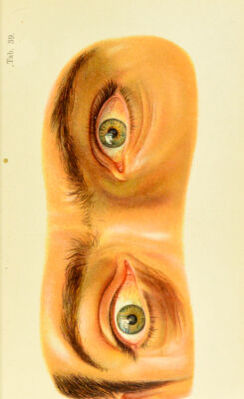
![]<:XTKRNAL t>tRXASl<:S OF THE EYE. Plate 39. Exophthalmos of the right ej-e, probably due to periostitis of the orbit. Patient is a baker, 20 years old, and was admitted to the clinic on account of grave .symptoms in the right eye, which lie first noticed two weeks ago. After violent cold and headaclie the eye became .so swollen that he could not open it. On raising the lid with the finger he found that he .saw double. The swelliug soon subsided, but the diplopia lemained, and the jiatient has to keep the right eye closed when he walks. Ihe eyeball is disiilaced forward and downward, about 8 mm. in each direction. The movements are much restricted in every direction, esjiccially upward. NV hen the eye is turned to the right, there is right diploiiia; when to the left, crossed diplopia (diminished abduction and adduction). When the gaze is directed upward the image of the right eye is also displaced upward. Visual acuity and eye-ground normal. On palpating between the orbital margin and the globe a tumor-like resistance is felt. The rhinopharyn.v is normal. No signs of syphilis. The patient’s condition continued for two weeks without change, and then disaiipeared entirely without treatment, fir.st the protrusion and then the dislocation downward. The cause is probably to be sought in a periostitis, secondary to catarrh of the frontal sinus. marked edemtitoiis swelling of the lids and ocular con- jnnctivti (eheinosis) and exophthalino.'S. The movements of the eyeball .soon suffer restriction and vision is often im]kiired or utterly de.‘^troyed. The subjective symptoms are even more .severe than in perio.stitis: Violent pain, vomiting, jfrostration, and slow pnl.se—altogether a very alarming clinical picture. The ab.scess may rupture and discharge its contents through a ])oint on the lids, marked by inten.se redness and swelling and by fluctuation. After the ])us is evacuated the inflammatory .symptoms may subside rajiidly; but a j)ermanent visual deterioration usually remains, becau.se orlfital phlegmons are very apt to produce inflammation and atrophy of the optic nerve. The bulbus itself may suffer permanent injury in the form of retinal .separation. If the inflammation is very .severe, panophthalmitis may result, and, as in the case of periostitis, lead to fatal ])urnlent meningitis and cerebral abscess. Among the causes of orbital abscess may be men- tioned :](https://iiif.wellcomecollection.org/image/b21691587_0290.jp2/full/800%2C/0/default.jpg)