Volume 1
A dictionary of chemistry and the allied branches of other sciences / by Henry Watts. Assisted by eminent contributors.
- Henry Watts
- Date:
- 1868-1871
Licence: Public Domain Mark
Credit: A dictionary of chemistry and the allied branches of other sciences / by Henry Watts. Assisted by eminent contributors. Source: Wellcome Collection.
18/1172 page 6
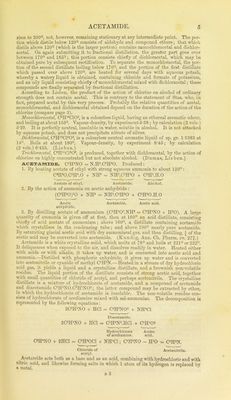
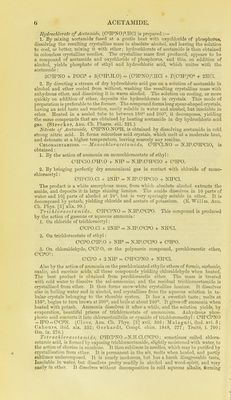
![Hydrochlorate of Acetamide, (C2H5N0)2.1IC1 is prepared:— 1. By mixing acetamide fused at a gentle heat with oxychloride of phosphorus, dissolving the resulting crystalline mass in absolute alcohol, and leaving the solution to cool, or better, mixing it with ether; hydroehlorate of acetamide is then obtained in colourless crystalline needles. The crystalline mass first produced, appears to be a compound of acetamide and oxychloride of phosphorus, and this, on addition of alcohol, yields phosphate of ethyl and hydrochloric acid, which unites with the acetamide: 2C2H5NO + POC13 + 3(C2H5.H.O) = (C'-IPNO)-.IICl + P(C2H5)30< + 2HC1. 2. By directing a stream of dry hydrochloric acid gas on a solution of acetamide in alcohol and ether cooled from without, washing the resulting crystalline mass with anhydrous ether, and dissolving it in warm alcohol. The solution on cooling, or more quickly on addition of ether, deposits the hydrochlorate in crystals. This mode of preparation is preferable to the former. The compound forms long spear-shaped crystals, having an acid taste and reaction, easily soluble in water and alcohol, but insoluble in ether. Heated in a sealed tube to between 180° and 200°, it decomposes, yielding the same compounds that are obtained by heating acetamide in dry hydrochloric acid gas. (Strecker, Ann. Ch. Pharm. ciii. 321.) Nitrate of Acetamide, C2H5N0.N03H, is obtained by dissolving acetamide in cold strong nitric acid. It forms colourless acid crystals, which melt at a moderate heat, and detonate at a higher temperature, leaving scarcely any residue. Chxoracetamides. — Monochloracetamide, CTI'Cl.NO = N.H2.C2H2C10, is obtained: 1. By the action of ammonia on monoehloraeetate of ethyl: C2H2C10.C2H5.0 + NH3 = N.H2.C2H2C10 + C2H60. 2. By bringing perfectly dry ammoniacal gas in contact with chloride of mono- chloracetyl: C2H2C10.C1 + 2NH3 = N.H'-’.CTPCIO + NH4C1. The product is a white amorphous mass, from which absolute alcohol extracts the amide, and deposits it in large shining laminae. The amide dissolves in 10 parts of water and 10§ parts of alcohol at 24°, but is very sparingly soluble in ether. It is decomposed by potash, yielding chloride and acetate of potassium. (E. 'Willm. Ann. Ch. Phys. [3] xlix. 99.) Trichloracetamide. C2H2C13N0 = N.IF.C2C130. This compound is produced by the action of gaseous or aqueous ammonia: 1. On chloride of txichloracetyl: C2C130.C1 + 2NH3 = N.II2.C2C130 + NH4C1. 2. On triehloracetate of ethyl: C2C130.C2H5.0 + NH3 = N.H2.C2C130 + C2H60. 3. On chloraldehyde, C2C14 0, or the polymeric compound, perchloracetic ether, CCFO2: C!C140 + 2 Nil3 = C2H2C13N0 + NII’Cl. Also by the action of ammonia on the perchlorinated ethylic ethers of formic, carbonic, oxalic, and succinic acids, all these compounds yielding chloraldehyde when heated. The best product is obtained from perchloracetic ether. The mass is treated with cold water to dissolve the sal-ammoniac, and the residual trichloraeetamide is crystallised from ether. It then forms snow-white crystalline laminae. It dissolves also in boiling water and in alcohol, and crystallises from the aqueous solution in ta- bular crystals belonging to the rhombic system. It has a sweetish taste; melts at 135°, begins to turn brown at 200°, and boils at about 240°. It gives off1 ammonia when heated with potash. Ammonia dissolves it after a while, and the solution yields, by evaporation, beautiful prisms of triehloracetate of ammonium. Anhydrous phos- phoric acid converts it into cliloracetonitrile or cyanide of triehloromethyl: C2H2C13N0 — H20 = C2C13N. (Cloez, Ann. Ch. Phys. [3] xvii. 305; Malaguti, ibid. xvi. 5 ; Cahours, ibid. xix. 352; Gerhardt, Compt. cliim. 1848, 277; Traits, i. 760; Gm. ix. 270.) Tctrachloracetamide, CHICl'NO — N.H.C1.C2C130 ; sometimes called chlora- cetamic acid, is formed by exposing trichloraeetamide, slightly moistened with water, to the action of chorine in sunsh inc. It then sublimes in needles, which may be purified by crystallisation from ether. It is permanent in the air, melts when heated, and partly sublimes undecomposed. It is nearly inodorous, but has a harsh disagreeable taste. Insoluble in water, but dissolves pretty readily in alcohol and wood-spirit, and very easily In ether. It dissolves without decomposition in cold aqueous alkalis, forming](https://iiif.wellcomecollection.org/image/b28117530_0001_0018.jp2/full/800%2C/0/default.jpg)
 No text description is available for this image
 No text description is available for this image
 No text description is available for this image