[Report 1938] / Medical Officer of Health, West Lancashire R.D.C.
- West Lancashire (England). Rural District Council.
- Date:
- 1938
Licence: Attribution 4.0 International (CC BY 4.0)
Credit: [Report 1938] / Medical Officer of Health, West Lancashire R.D.C. Source: Wellcome Collection.
110/138 page 104
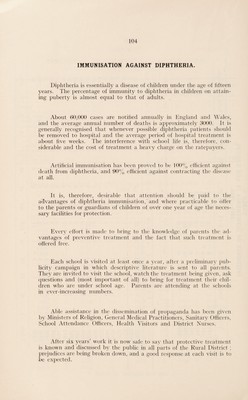
![IMMUNISATION AGAINST DIPHTHERIA. Diphtheria is essentially a disease of children under the age of fifteen years. The percentage of immunity to diphtheria in children on attain¬ ing puberty is almost equal to that of adults. About 60,000 cases are notihed annually in England and W'ales, and the average annual number of deaths is approximately 3000. It is generally recognised that whenever possible diphtheria patients should be removed to hospital and the average period of hospital treatment is about hve weeks. The interference with school life is, therefore, con¬ siderable and the cost of treatment a heavy charge on the ratepayers. Artificial immunisation has been proved to be 100% efficient against death from diphtheria, and 90% efficient against contracting the disease at all. It is, therefore, desirable that attention should be ]iaid to the advantages of diphtheria immunisation,'and where practicable to offer to the parents or guardians of children of over one year of age the neces¬ sary facilities for protection. Every effort is made to bring to the knowledge of parents the ad¬ vantages of preventive treatment and the fact that such treatment is offered free. Each school is visited at least once a year, after a preliminary pub¬ licity campaign in which descriptive literature is sent to all parents. They are invited to visit the school, watch the treatment being given, ask questions and (most important of all) to bring for treatment their chil¬ dren who are under school age. Parents are attending at the schools in ever-increasing numbers. Able assistance in the dissemination of propaganda has been gi\'en by Ministers of Religion, General Medical Practitioners, Sanitary Officers, School Attendance Officers, Health Visitors and District Nurses. After six years’ work it is now safe to say that protective treatment is known and discussed by the public in all parts of the Rural District ; prejudices are being broken down, and a good response at each visit is to be expected.](https://iiif.wellcomecollection.org/image/b30261648_0110.jp2/full/800%2C/0/default.jpg)