A review of certain present aspects of smallpox prevention in relation particularly to the Vaccination Acts, 1867-1907.
- Date:
- 1931
Licence: Public Domain Mark
Credit: A review of certain present aspects of smallpox prevention in relation particularly to the Vaccination Acts, 1867-1907. Source: Wellcome Collection.
11/68 (page 11)
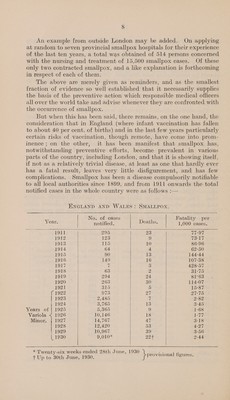
![1] “ alastrim-smallpox,” but the latter then becomes clumsier than “ variola minor.” Referring to the table above, variola minor may have been, and no doubt was, responsible for certain of the smallpox sporadic out- breaks which made up the totals of notified cases between 1911 and 1922,* but in the main the history of these cases was that they represented small limited outbreaks of variola major, originating in imported infection. From 1923 onwards however, the prevalence has been almost entirely of the minor variety, although at intervals groups of cases of variola major have been included in circumstances pointing to the introduction of a separate and imported infection. Clinical Characteristics of Variola Minor. On account of the mildness of the smallpox prevalent in 1922, and of the lack of experience of the disease amongst the younger school of practitioners by reason of the almost complete absence of smallpox from this country for many years, errors in diagnosis were com- paratively frequent. The Minister of Health appointed a Committee of experienced medical men to visit the various places where the medical profession were in doubt as to the nature of the prevailing ilmess. The Committee came unanimously to the conclusion that there was no reason for regarding the ‘‘ doubtful”: cases they had seen in which the eruption was present as other than smallpox of benign character. In the following year the clinical features of variola minor were described as follows :—t “The disease is usually ushered in by a sharp, sudden illness characterised by headache, pyrexia, sweating, pain in the back and limbs, and vomiting—occasionally delirium is met with. A provisional diagnosis of influenza is common. The initial symptoms may be insignificant. In some cases no history of illness can be obtained. The severity of the constitutional symptoms is no criterion of the extent of the characteristic eruption, which itself may or may not be preceded by a pro- dromal rash, and which in the matter, time and place of its appearance differs little from that observed in the more severe attacks. Sometimes, however, the rash appears on the extrem- ities as much as twenty-four hours later than on the face. The evolution of the eruption, where such proceeds, is regular, and although it conforms generally to the classical type the lesions are apt to pass through their successive stages with increased rapidity (papule, vesicle, pustule, crust). On the other hand, they may abort wholly or partially in any stage. These phenomena have led to an appearance suggesting to some *This was the case in certain instances (Oldham 1913, Milnrow 1914) in which infection of the minor variety was believed to have been introduced by raw cotton from America.](https://iiif.wellcomecollection.org/image/b32178669_0011.jp2/full/800%2C/0/default.jpg)