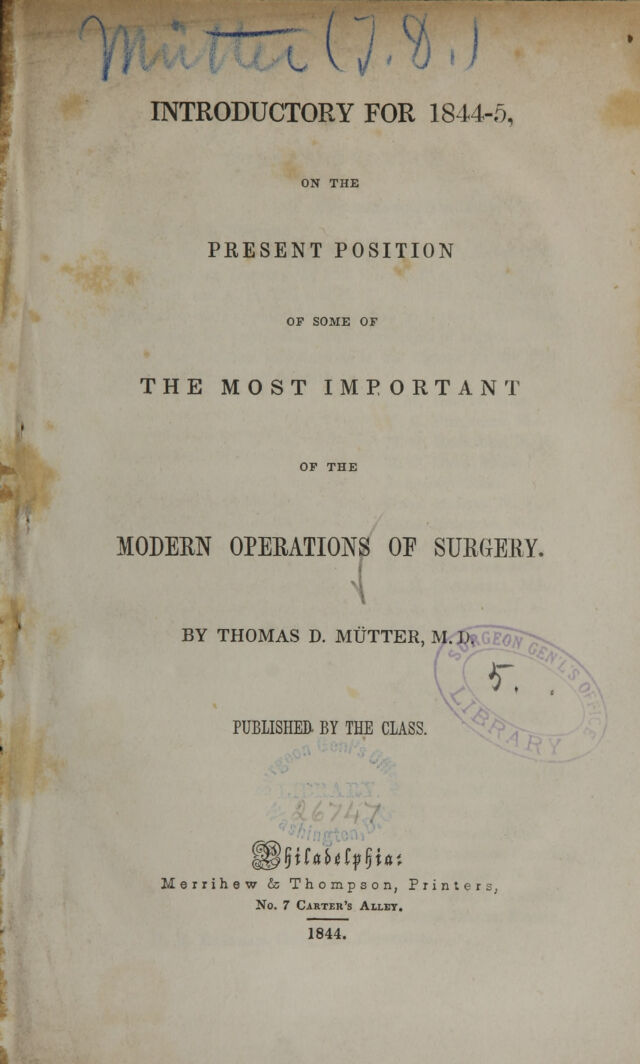
Introductory for 1844-5 : on the present position of some of the most important of the modern operations of surgery / by Thomas D. Mütter.
- Thomas Dent Mutter
- Date:
- 1844
Licence: Public Domain Mark
Credit: Introductory for 1844-5 : on the present position of some of the most important of the modern operations of surgery / by Thomas D. Mütter. Source: Wellcome Collection.
Provider: This material has been provided by the National Library of Medicine (U.S.), through the Medical Heritage Library. The original may be consulted at the National Library of Medicine (U.S.)
8/36
![honours—but simply to the fact, that I consider myself but the exponent of the views of the majority of the best mo- dern surgeons of Europe, and hence compelled, in all honour, to state candidly and fairly what these views are. The first point of interest to which I shall direct your at- tention, is the manner in which extensive wounds are dres- sed, at the present time, in Europe, and you will naturally enough be surprised to learn that in a matter of such com- mon occurrence, and often of such vital importance, there should exist any diversity of opinion among surgeons as to the proper method of treatment, and yet there is scarcely a point in practical surgery, that has elicited more] contro- versy and discussion. The French surgeons, with but very few exceptions, still adhere to the original views of some ot their older authorities, and unite all extensive wounds by the second intention of Hunter; while the English, like ourselves, adopt a plan directly the reverse, and endeavor to obtain, as far as possible, union by the first intention of Hunter, or simple adhesion. It afforded me no slight gratifi- cation to find, that the principles I have so often inculcated here, in reference to this subject, should be those upon which the practice of such men as Brodie, Lawrence, Stan- ley, Liston, Guthrie, Fergusson, Key, Philips, and others of high reputation, has for many years been based, and I was thus fully convinced of the propriety of attempting, when the case justifies such an attempt, the immediate union of a wound. I cannot, at this time, present you with the arguments advanced by the French for adhering to the reverse of this treatment, but on a proper occasion they will all be fully explained. From what I could learn, the continental surgeons, out of France, are gradually adopting the modern English and American method ; and instead of covering up their wounds with great bundles of charpie, apply the lightest ^dressing, frequently employ cold water, as recommended recently by](https://iiif.wellcomecollection.org/image/b21142968_0008.jp2/full/800%2C/0/default.jpg)


 No text description is available for this image
 No text description is available for this image
 No text description is available for this image