The Fauna of British India, including Ceylon and Burma / edited by A.E. Shipley, assisted by Guy A.K. Marshall. Orthoptera. (Acridiidae) / by W.F. Kirby.
- Date:
- 1914
Licence: In copyright
Credit: The Fauna of British India, including Ceylon and Burma / edited by A.E. Shipley, assisted by Guy A.K. Marshall. Orthoptera. (Acridiidae) / by W.F. Kirby. Source: Wellcome Collection.
Provider: This material has been provided by London School of Hygiene & Tropical Medicine Library & Archives Service. The original may be consulted at London School of Hygiene & Tropical Medicine Library & Archives Service.
15/296 (page 1)
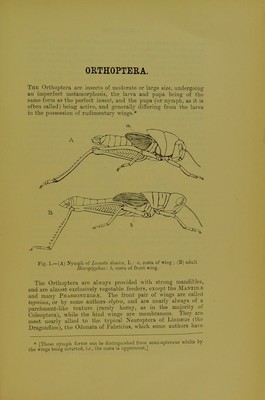
![ORTHOPTERA. The Orthoptera ai'e insects of moderate or large size, undergoiug^ au imperfect metamorphosis, the larva and pupa being of the same form as the perfect insect, and the pupa (or nymph, as it is often called) being active, and generally diiSering from the larva in the possession of rudimentary wings.* OL, Fig. 1.—(A) Nymph of Locusta danica, L.: a, costa of wing ; (B) adult Hieroglyphus : b, costa of front wing. The Orthoptera are always provided with strong mandibles, and are almost exclusively vegetable feeders, except the Mantid.h and many Phasgonduid^, The front pair of wings are called tecjmina, or by some authors elytra, and are nearly always of a parchment-like texture (rarely horny, as in the majority of Coleoptera), while the hind wings are membranous. They are most nearly allied to the typical Neuroptera of Linnaeus (the Uragouflies), the Odonata of i\abricius, which some authors have * [These nyiupb forms can be distiuguisbed fi-ora semi-apterous adults by the wings being inverted, i.e., the costa is uppermost,]](https://iiif.wellcomecollection.org/image/b21352768_0015.jp2/full/800%2C/0/default.jpg)