The Fauna of British India, including Ceylon and Burma / edited by A.E. Shipley, assisted by Guy A.K. Marshall. Orthoptera. (Acridiidae) / by W.F. Kirby.
- Date:
- 1914
Licence: In copyright
Credit: The Fauna of British India, including Ceylon and Burma / edited by A.E. Shipley, assisted by Guy A.K. Marshall. Orthoptera. (Acridiidae) / by W.F. Kirby. Source: Wellcome Collection.
Provider: This material has been provided by London School of Hygiene & Tropical Medicine Library & Archives Service. The original may be consulted at London School of Hygiene & Tropical Medicine Library & Archives Service.
17/296 (page 3)
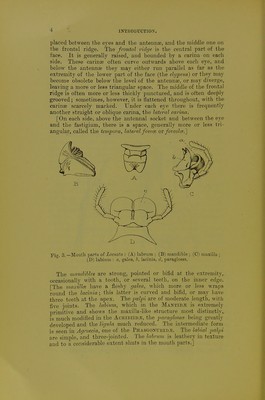
![These ai-e species of large or moderate size, but mauy of the smaller kinds sometimes occur in large numbers and do c^i-eat harm to crops and vegetation ; some preferring particular food- plants, whilst others are almost omnivorous.] Structure. In the AcEiBiiDiE the head is usually short and broad. The compound eyes are placed one on each side, and sometimes approximate very closely above. More frequently they are separated by a space as great or greater than tlieir diameter; and they are sometimes raised above the level of the rest of the Face of Locusta. Head of AtTactomwpha^ 6L—4- Fig. 2.—(A) Face of Locusta : a, eye, b, h, ocelli, c, frontal ridge, d, d, lateral carinae, e, e, tempora, or foveoles, f, clypeus, g, labi-iiin ; (B) head of Atractomorplms: h, fastigium, i, i, foveolic. head. The head is usually horizontal, but is occasionally obliquely raised. The extremity carves into the face, or is separated from it by a transvei'se carina; not uuf'requently it is more or less produced between and beyond the antennae, and this prolongation is called the fastigium. [The extreme apex of the fastigium is sometimes called the scutellum of vertex.'] The antenna) are generally placed between or below the eyes. .There are usually three ocelh, or simple eyes, the lateral ones 032](https://iiif.wellcomecollection.org/image/b21352768_0017.jp2/full/800%2C/0/default.jpg)