The Fauna of British India, including Ceylon and Burma / edited by A.E. Shipley, assisted by Guy A.K. Marshall. Orthoptera. (Acridiidae) / by W.F. Kirby.
- Date:
- 1914
Licence: In copyright
Credit: The Fauna of British India, including Ceylon and Burma / edited by A.E. Shipley, assisted by Guy A.K. Marshall. Orthoptera. (Acridiidae) / by W.F. Kirby. Source: Wellcome Collection.
Provider: This material has been provided by London School of Hygiene & Tropical Medicine Library & Archives Service. The original may be consulted at London School of Hygiene & Tropical Medicine Library & Archives Service.
18/296 (page 4)
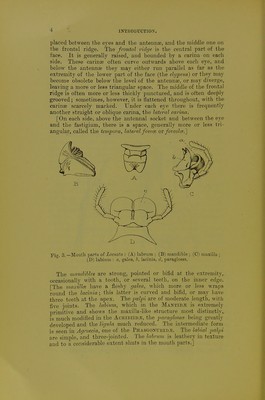
![1NTH0I)T7CTI0N. placed between the eyes and the antenna9, and the middle one on the frontal ridge. The fronted ridge is the central part of the face. It is generally raised, and bounded by a carina on each side. These carina) often curve outwards above each eye, and below the antennae they may either run parallel as far as the extremity of the lower part of the face (the dypeus) or they may become obsolete below the level of tlie antenna), or may diverge, leaving a more or less triangular space. The middle of the frontal ridge is often more or less thickly punctured, and is often deeply grooved; sometimes, however, it is tiattened throughout, with the carinae scarcely marked. Under each eye there is frequently another straight or oblique carina, the lettered carina. [On each side, above the antennal socket and between the eye and the fastigium, there is a space, generally more or less tri- angular, called the temporci, latered fovece ov foveolce.^ -pic 3.—Moutb parts Locust a : (A) labriim ; (B) niaiidible ; (C) luaxilla ; ° (D) labium : a, galea, h, lacinia, cJ, pavaglossa. The mandibles are strong, pointed or bifid at the extremity,, occasionally with a tooth, or several teeth, on the inner edge. [The maxillce have a fleshy rjalea, which more or less wraps round the lacinia; this latter is curved and bifid, or may have three teeth at the apex. The palpi are of moderate length, with five joints. The leibium, which in the Mantidje is extremely primitive and shows the maxilla-like structure most distinctly,, is much modified in the Acridiidje, the peirafiloasce being greatly developed and the lir/ula much reduced. The intermediate foru) is seen in Arjroecia, one of the Phasgonukidje. The labial pedpi are simple, and three-jointed. The lah-um is leathery in texture and to a considerable extent shuts in the mouth parts.]](https://iiif.wellcomecollection.org/image/b21352768_0018.jp2/full/800%2C/0/default.jpg)