The Fauna of British India, including Ceylon and Burma / edited by A.E. Shipley, assisted by Guy A.K. Marshall. Orthoptera. (Acridiidae) / by W.F. Kirby.
- Date:
- 1914
Licence: In copyright
Credit: The Fauna of British India, including Ceylon and Burma / edited by A.E. Shipley, assisted by Guy A.K. Marshall. Orthoptera. (Acridiidae) / by W.F. Kirby. Source: Wellcome Collection.
Provider: This material has been provided by London School of Hygiene & Tropical Medicine Library & Archives Service. The original may be consulted at London School of Hygiene & Tropical Medicine Library & Archives Service.
41/296 (page 27)
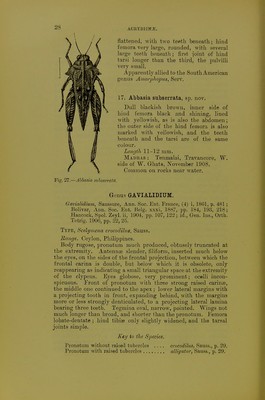
![16. Scelimena (?) bii-manica, Bnmn. Gavialidiwn birvicmicum, Erunnev von Wattenwy], Ann. Mus. Geneva, XA-xiii, 1893, p. 104, pi. V, fig. 37. Euijavialidium bmnmiica, Hancock, Gen. Ins., Orth. Tetrio-, 1906 p. 25. ' Clay-brown, with dark markings. Vertex obtuse, about as broad as llie eye. Pronotum with raised tubercles on the disc, parallel with the longitudinal marginal cariuulaj; ^ ith the deflexed lobes obtusely dentated in front, produced behind into a straight triangular lobe, neither pointed nor curved forwards ; humeral angle very finely crenulated, with a pale obtuse tubercle ; the process with very acute longitudinal carinas extending to the tip, with pale crenules far apart. Hind femora above very slightly Maved, with a nearly entire carina above; hind tibiae simple. Subgenital lamina of the male roundly produced. Length, body. . .. c? 10-5 mm., $ 12-5 mm. „ pronotum 15-5 mm., 17 mm. „ hind femur 7 mm., 9*4 mm. Burma : Karen Hills. Type in the Grenoa Museum. In the shape of the lateral spine this species resembles S. harpago, and in the shape of the front of the pronotum S. contracta. Although the hind tibiae are called entire, the figure shows four teeth on the outer margin. They are repre- sented as gradually and widely laminate ; and the basal joint of the tarsi also appears to be expanded and is in any case much broader than the terminal joint, as is also the short middle joint. The first joint is longer than the third. I have placed this species ])i'Ovisionally in Scelimena, to which it appears to have as much affinity as with the genera in which it has been placed by previous authors. Grenus ABBASIA, nov. Type, Abbasia suhserrata, sp. nov. Range. Travancore. Body depressed, but traversed by a central undulating carina; space between the eyes about as wide as the eyes, which are large and prominent; head not produced. Antennae slender, rather longer than the head, placed distinctly below the eyes. Pronotum in front with two distinct lateral carinae, ceasing, and then continued by three longitudinal callosities; there is also an irregular outer carina, continued towards the end of the pro- notum, before reaching which it forms a small angle and dis- appears. Wings shorter than the abdomen, which, agani, is shorter than the pronotum ; the latter with a truncated lobe on each side, turned downwards and backwards. Front femora flattened, with one tooth above and two beneath ; middle femora](https://iiif.wellcomecollection.org/image/b21352768_0041.jp2/full/800%2C/0/default.jpg)