The stability and solubility of diphtheria toxin in acid and alkili / Una Wallace.
- Wallace, U.
- Date:
- [1927?]
Licence: In copyright
Credit: The stability and solubility of diphtheria toxin in acid and alkili / Una Wallace. Source: Wellcome Collection.
4/8 page 670
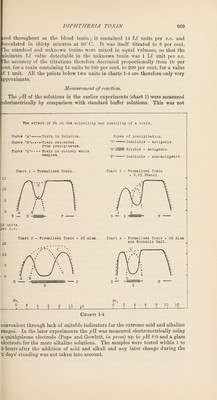
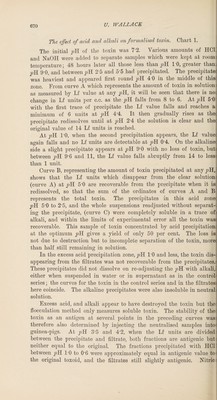
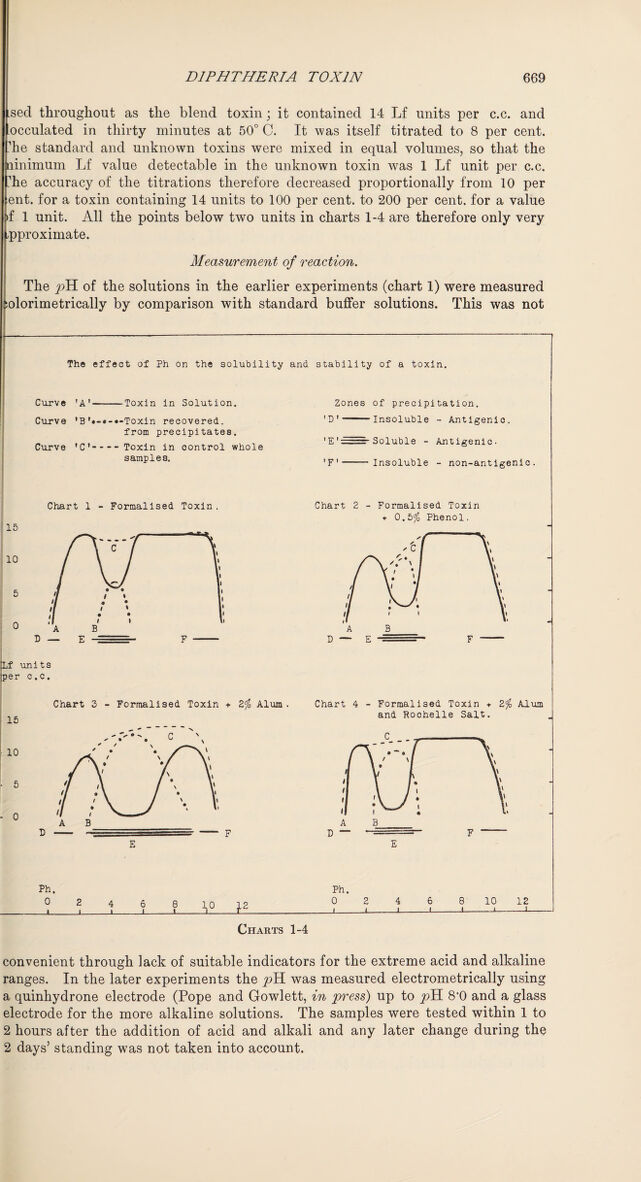
![The effect of acid and alkali on formalised toxin. Chart 1. The initial pR of the toxin was 7*2. Various amounts of HC1 and NaOH were added to separate samples which were kept at room : temperature; 48 hours later all those less than joH 10, greater than: pR 9‘0, and between 2*5 and 5*5 had precipitated. The precipitate was heaviest and appeared first round pR 40 in the middle of this/ From curve A which represents the amount of toxin in solution: zone. as measured by Lf value at any ^H, it will be seen that there is no : change in Lf units per c.e. as the pR falls from 8 to 6. At pR 5*0 with the first trace of precipitate the Lf value falls and reaches a minimum of 6 units at pR 4*4. It then gradually rises as the*] precipitate redissolves until at pR 2-4 the solution is clear and the! original value of 14 Lf units is reached. At pR 1*0, when the second precipitation appears, the Lf value again falls and no Lf units are detectable at pR 0 4. On the alkaline! side a slight precipitate appears at pR 9*0 with no loss of toxin, but i between pR 9’6 and 11, the Lf value falls abruptly from 14 to less-i than 1 unit. Curve B, representing the amount of toxin precipitated at anyjflHJ shows that the Lf units which disappear from the clear solution: (curve A) at pR 5*0 are recoverable from the precipitate when it iso redissolved, so that the sum of the ordinates of curves A and B represents the total toxin. The precipitates in this acid zone:: pR 5*0 to 2*5, and the whole suspensions readjusted without separat-. ing the precipitate, (curve C) were completely soluble in a trace on alkali, and within the limits of experimental error all the toxin wasrs recoverable. This sample of toxin concentrated by acid precipitation: at the optimum pR gives a yield of only 50 per cent. The loss is: not due to destruction but to incomplete separation of the toxin, more than half still remaining in solution. In the excess acid precipitation zone, pR 1*0 and less, the toxin dis- ajypearing from the filtrates was not recoverable from the precipitates. These precipitates did not dissolve on re-adjusting the pR with alkali, either when suspended in water or in supernatant as in the control series; the curves for the toxin in the control series and in the filtrates here coincide. The alkaline precipitates were also insoluble in neutral solution. Excess acid, and alkali appear to have destroyed the toxin but the! flocculation method only measures soluble toxin. The stability of the I toxin as an antigen at several points in the preceding curves was i therefore also determined by injecting the neutralised samples into guinea-pigs. At pR 3*5 and 4*2, when the Lf units are divided between the precipitate and filtrate, both fractions are antigenic but neither equal to the original. The fractions precipitated with HC11 between pR 1*0 to 0*6 were approximately equal in antigenic value to the original toxoid, and the filtrates still slightly antigenic. Nitric](https://iiif.wellcomecollection.org/image/b30626535_0004.jp2/full/800%2C/0/default.jpg)