The stability and solubility of diphtheria toxin in acid and alkili / Una Wallace.
- Wallace, U.
- Date:
- [1927?]
Licence: In copyright
Credit: The stability and solubility of diphtheria toxin in acid and alkili / Una Wallace. Source: Wellcome Collection.
6/8 page 672
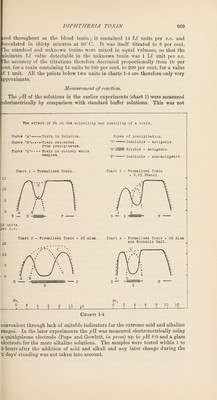
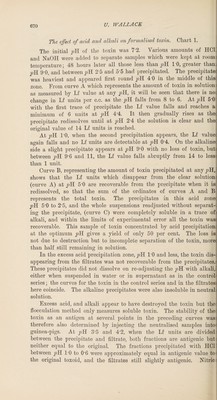
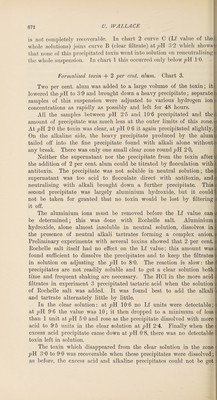
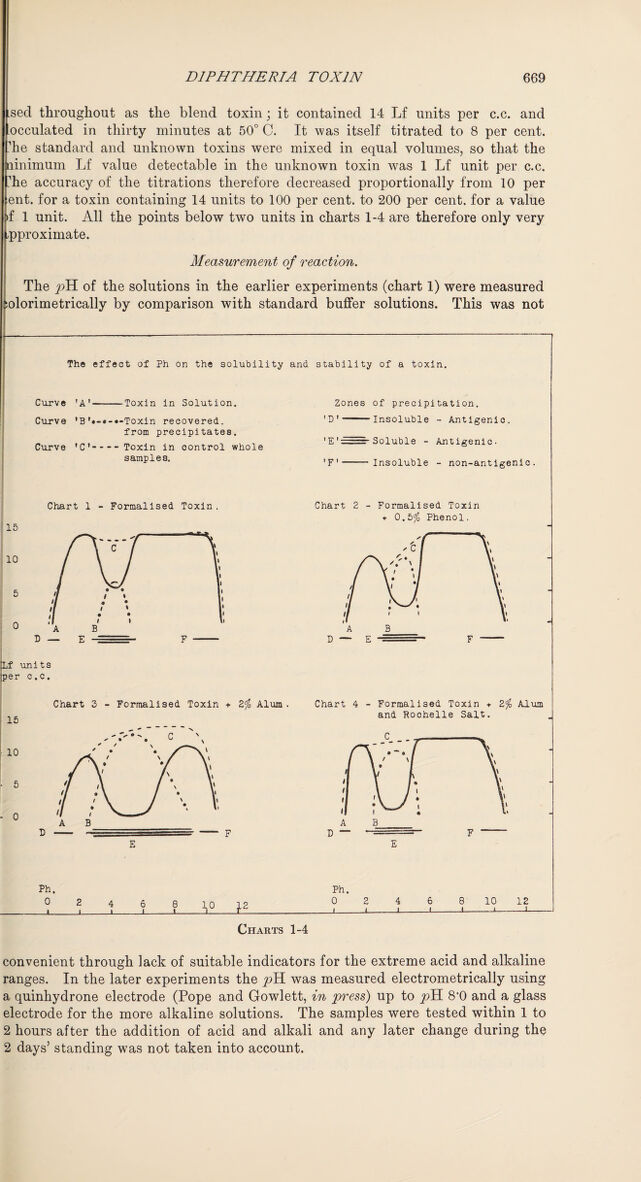
![is not completely recoverable. In chart 2 curve C (Lf value of the whole solutions) joins curve B (clear filtrate) at y>H 3*2 which shows /' that none of this precipitated toxin went into solution on reneutralising in the whole suspension. In chart 1 this occurred only below pH 1*0. Formalised toxin + 2 per cent. alum. Chart 3. Two per cent, alum was added to a large volume of the toxin; it: lowered thepH to 3’9 and brought down a heavy precipitate; separate) samples of this suspension were adjusted to various hydrogen iont concentrations as rapidly as possibly and left for 48 hours. All the samples between pH 2*5 and iO’6 precipitated and the: amount of precipitate was much less at the outer limits of this zone, e At pH 2’0 the toxin was clear, aty>H 0*6 it again precipitated slightly. ; On the alkaline side, the heavy precipitate produced by the alumii tailed off into the fine precipitate found with alkali alone withoutp any break. There was only one small clear zone round pH 2'0. Neither the supernatant nor the precipitate from the toxin after ) the addition of 2 per cent, alum could be titrated by flocculation with ] antitoxin. The precipitate was not soluble in neutral solution; the: supernatant was too acid to flocculate direct with antitoxin, and v neutralising with alkali brought down a further precipitate. This second precipitate was largely aluminium hydroxide, but it could |j not be taken for granted that no toxin would be lost by filtering n it off. | The aluminium ions must be removed before the Lf value can a be determined; this was done with Bochelle salt. Aluminium u hydroxide, alone almost insoluble in neutral solution, dissolves in i the presence of neutral alkali tartrates forming a complex anion. t< Preliminary experiments with several toxins showed that 2 per cent, r Rochelle salt itself had no effect on the Lf value; this amount wasi found sufficient to dissolve the precipitates and to keep the filtrates • in solution on adjusting the pH to 8*0. The reaction is slow: the :l precipitates are not readily soluble and to get a clear solution both 3 time and frequent shaking are necessary. The HC1 in the more acid i filtrates in experiment 3 precipitated tartaric acid when the solution f of Rochelle salt was added. It was found best to add the alkali 1 and tartrate alternately little by little. In the clear solution: at pH 10'6 no Lf units were detectable; -: at pH 9'6 the value was 10; it then dropped to a minimum of less : than 1 unit at pH 5’0 and rose as the precipitate dissolved with more i acid to 95 units in the clear solution at pH 2*4. Finally when the excess acid precipitate came down at pH 0-8, there was no detectable 1 toxin left in solution. The toxin which disappeared from the clear solution in the zone | pH 3*0 to 90 was recoverable when these precipitates were dissolved; I as before, the excess acid and alkaline precipitates could not be got ]](https://iiif.wellcomecollection.org/image/b30626535_0006.jp2/full/800%2C/0/default.jpg)