A dictionary of terms used in medicine and the collateral sciences / by Richard D. Hoblyn.
- Richard Hoblyn
- Date:
- 1858
Licence: Public Domain Mark
Credit: A dictionary of terms used in medicine and the collateral sciences / by Richard D. Hoblyn. Source: Wellcome Collection.
12/692 (page 4)
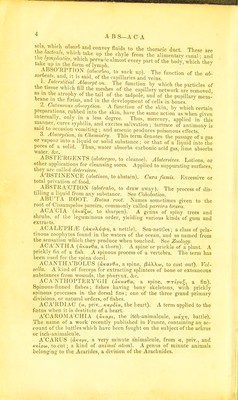
![* A B S—A C A tit'/?^!''/ '^^•^y '^''^^ t'^e tl^o-'-'^cic duct. These are P fl '-'f'^' ^ f'-o' t'-'^ aliraentarv canal Tnd soioe/iU, and, it is said, of the capillaries and veins the tif^'nrff-/ fu:Z^* ''\ '^H hich the particles of in Z 7 . t'^ •^'''•'•■•y removed, as in the atrophy ot the tail of the tadpole, and of the pupillary mem- brane in the fictus, and in the development of cells in bones Cutaneous ab^orptioH A function of the slcin, by ^yhich certain pieparations, rubbed into the skin, have the same action as Nvhen -riven internally, only in a less degree. Thus, mercury, applied in this manner, cures syphilis, and e.xeites salivation ; tartrate of antimony is saul to occasion vomiting; and arsenic produces poisonous effects .i. Ahsorphoii, in Cliemistrj/. 'J'his term denotes tlie passage of a eas or vapour into a liquid or solid substance; or that of a liquid into the pores ot a solid. Thus, \vater absorbs carbonic acid gas, lime absorbs \vater, &c. ABSTE'RGENTS (ahsiergeo, to cleanse). Abstersives. Lotions or other applications for cleansing sores. Applied to suppurating surfaces they are called (/efcrsrora. A'BSTINENCE (afoCuifio, to abstain). Cura famis. K.xcessive or total privation of food. AB8TRA'CTI0N (ahstraho, to draw away). The process of dis- tilling a liquid from any substance. See Cohobation. ABU'fA ROOT. Biilua rout. Names sometimes given to the root of Cissampelos pareira, commonly called paj-eme brava. ACA'CIA (di^dX^u), to sharpen). A genus of spiny trees and shrubs, of the leguminous order, yielding various kinds of gum and extracts. ACALE'PH.^ («/f<<\i)(/)i|, a nettle). Sea-nettles; a class of gela- tinous zoophytes found in the waters of the ocean, and so named from the sensation which they produce when touched. See Zoology. ACA'NTHA (aiv-ai/da, a thorn). A spine or prickle of a plant. A prickly fin of a fish. A spinous process of a vertebra. The term has been used for the spina dorsi, ACANTHA'BOLUS (uKavSa, a spine, /SaWai, to cast out). Vol- sclla. A kind of forceps for e.\tracting splinters of bone or extraneous substances frnni wounds, the pharynx, &c. ACA'NTHOPTERY'GII (aKai/tJa, a spine, TTTfouf, a fin). Spinous-finned fishes; fishes having bony skeletons, with prickly spinous processes in the dorsal fins; one of the three grand primary divisions, or natural orders, of fishes. ACA'RDIAC (a, priv.. KapSia, the lieart). A term applied to the foetus when it is destitute of a heart. A'CAROMA'CHIA (uKapt, the itch-.aninialcule, /mdx'l, battle). The name of a work recently published in France, containing an ac- count of the battles which have been fought on the subject of the acarus or itcli-animalcule. A'CARUS {aKrtfii, a very minute animalcule, from a, ])riv., and Ktipui, to cut; a kind of aniimil atom). A genus of minute animals belonging to the Acarides, a division of the Arachnides.](https://iiif.wellcomecollection.org/image/b21780468_0012.jp2/full/800%2C/0/default.jpg)