Experiments on the metabolism of matter and energy in the human body, 1898-1900 / by W.O. Atwater and F.G. Benedict ; with the cooperation of A.P. Bryant and A.W. Smith and J.F. Snell.
- Wilbur Olin Atwater
- Date:
- 1902
Licence: In copyright
Credit: Experiments on the metabolism of matter and energy in the human body, 1898-1900 / by W.O. Atwater and F.G. Benedict ; with the cooperation of A.P. Bryant and A.W. Smith and J.F. Snell. Source: Wellcome Collection.
140/152 page 138
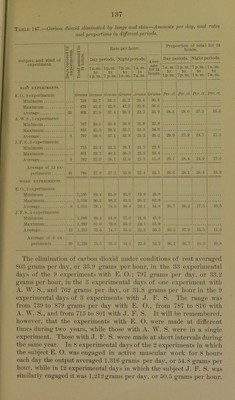
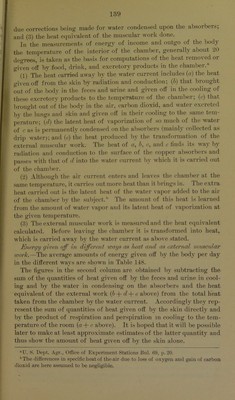
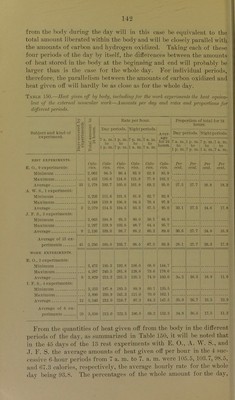
![During the rest experiments, in Avhieh the subjects had as little muscular activity us possible, there was but little difference in the elimination of carbon dioxid during the two day and ffi'st night periods. In the 9 experiments with E. O. the average rate per hour during these three periods was 37.9, 37.1, and 36.2 grams, respectively. In the experiment with A. W. S. there was a slightly larger amount of carbon dioxid eliminated in the ffrst two ])eriods than in the third period, the rates being 39.8, 37.1, and 32.8 grams, respectively. In the 4 experiments with J. F. S. the elimination during the first three periods averaged 37, 36.1, and 31.6 grams per hour, respectively. During the second night period, when the subject was generall}'asleep for nearly the whole time, the output fell off' with E. O. to 22.3, with A. W. S. to 23.2, and with J. F. S. to 22.3 grams per hour. Not only are the averages with the 3 men in close accord, but the range of valua- tion in the different daj's and experiments is decidedly narrow for all. In the average of the 13 experiments the proportion given off in each of the four periods of the da} is 28.6, 28.1, 26.4, and 16.9 per cent, respectively. The elimination of carbon dioxid in the two day periods of the work experiments was more than twice as large as in the two day periods of the rest experiments. With E. O. the average amounts given off' were 78.4 grams in the ffrst and 79.5 in the second day period when at work, as compared with 37.9 and 37.4 grams, respectively, when at rest. With J. F. S. the amounts averaged 73.6 and 74.7 grams in the daj periods of the work experiments, as compared with 37 and 36.1 grams in the corresponding periods of the rest experiments. The elimination in the two night periods averaged with E. O. 38.4 and 23.1 grams in the work experiments, as compared with 36.2 and 22.3 grams in the rest experiments, the differences being small; with J. F. S. the amounts were practically identical, being 31.3 and 22.3 grams in the work experiments, as compared with 31.6 and 22.3 grams in the rest experiments. The uniformit}’^ in the amounts of carbon dioxid given off during the second night period in all the experiments is very noticeable. Such data may perhaps be taken as an approximate measure of the metabolism of carbon in the body of an active healthy man when at its lowest ordinary ebb. ELIMINATION OF ENERGY. Measv.Teinents of enet'gy.—The kinetic energy given off by the body is measured in these experiments as the sum of three quantities: (1) The heat taken up by the water current in its passage through the cham- ber; (2) the latent heat of the water vapor given off by the body—i. e., of the water vaporized b} its heat and carried out in the air cuiient,](https://iiif.wellcomecollection.org/image/b28113408_0140.jp2/full/800%2C/0/default.jpg)



 No text description is available for this image
 No text description is available for this image
 No text description is available for this image