Volume 1
A text-book of human physiology : including histology and microscopical anatomy : with special reference to the requirements of practical medicine / by L. Landois ; translated from the seventh German edition, with additions, by William Stirling.
- Date:
- 1891
Licence: Public Domain Mark
Credit: A text-book of human physiology : including histology and microscopical anatomy : with special reference to the requirements of practical medicine / by L. Landois ; translated from the seventh German edition, with additions, by William Stirling. Source: Wellcome Collection.
Provider: This material has been provided by the Royal College of Physicians of Edinburgh. The original may be consulted at the Royal College of Physicians of Edinburgh.
111/602 page 71
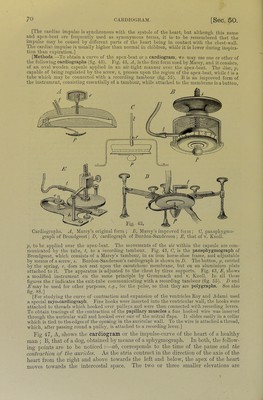
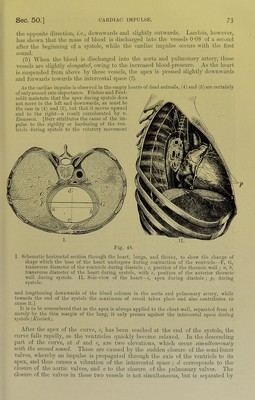
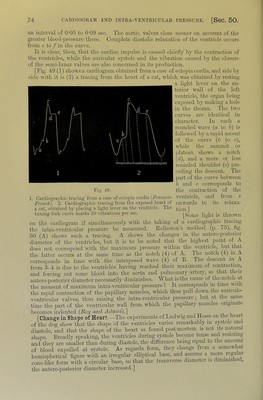
![perhii])s cauaea l>y tlio contractions of the ends of the veins, the auricular appendices, and the atria themselves. _ The portion he, which communicates the greatest impulse to the instrument, and also to one’s hand when it is placed on the apex-heat, is caused hy the contraction of the ventricles, and during it the first sound of the heart occurs. By some observers the cardiac impulse has been ascribed to the contraction of the ventricles alone. It, however, is due to all those conditions which cause an eleva- tion in the region of the cardiac impulse. rEd^reii i-ecoriled a luinian cardiogmm, and listened at the same time to the heart-sounds, recording the latter by means of an electric signal. The curve rises at a, with the beginning ot the first sound, i.e., witli the contraction of the ventricles, and reaches the abscissa at/with the beginning of the second sound,f.c., when the semi- lunar valves are closed. The relation between a and the points interme- diate between itand/and to the pulse-curve of the carotid, is shown in fig. 45. The letters with the dash correspond to the unmarked letters in the cardiogram.] Cardiogram. Fig. 44. a-/; 1, beginning of 1st, and 2, 2nd sound. j ■ — a 1 a, in n r ffi [While all observers are agreed as to the position of the occurrence of the first sound in a cardiogram, they difler very considerably as to the position of the second sound, i.e.,the closure of the semi-lunar valves (fig. 46). Martins places it in the depression between c and d (fig. 47, E); Landois at the two projection; d and e, d corresponding to the closure 0 the aortic, and e to that of the jiulmonar valves ; Marey and Fredericq about tin middle between e and/, and Edgren at the point/. According to Landois, the part hi (fig. 47, A) is due to the contraction of tin ventricles, and from c onwards the ventri- cular musculature begins to relax and last.- from c to /. It is plain from the diagram that according to Landois the closure of the semi-lunar valves takes place earlier (at d and e) than according to Marey is the case. Fredericq has recently re-investigated the subject on the dog’s heart, and agrees with xhe upper curve from the human carotid; the lower ct Fig. 45. Marey that the closure of the semi-lunar valves takes place at e. See also fig. 46.] a cardiogram taken simultaneousl}\ Tlie cause of the cardiac impulse has been muck discussed. It depends upon the following :— (1) The base of the heart (auriculo-ventricular groove) represents during diastole a transversely-placed ellipse (fig. 48, I., TG), while during contraction it has a more circular figure, ah. Thus, the long diameter of the ellipse (FG) is diminished, the small diameter dc is increased, while the base is brought nearer to the chest-wall e. This alone does not cause the impulse, but the basis of the heart, being hardened during the systole and Ijrought nearer to the chest-wall, allows the apex to execute the movement which causes the impulse (p. 69). (2) During relaxation the ventricle lies with its apex (fig. 48, II., i) obliquely downwards, and with its long axis in an oblique direction—so that the angles [hei, aci) formed by the axis of the ventricles with the diameter of the base arc unequal —during systole it represents a regular cone, with its axis at right angles to its ba.se. Hence the a[>ex (i) must be erected from below and behiml (/), forwards](https://iiif.wellcomecollection.org/image/b21981516_0001_0111.jp2/full/800%2C/0/default.jpg)



 No text description is available for this image
 No text description is available for this image
 No text description is available for this image