Volume 1
A text-book of human physiology : including histology and microscopical anatomy : with special reference to the requirements of practical medicine / by L. Landois ; translated from the seventh German edition, with additions, by William Stirling.
- Date:
- 1891
Licence: Public Domain Mark
Credit: A text-book of human physiology : including histology and microscopical anatomy : with special reference to the requirements of practical medicine / by L. Landois ; translated from the seventh German edition, with additions, by William Stirling. Source: Wellcome Collection.
Provider: This material has been provided by the Royal College of Physicians of Edinburgh. The original may be consulted at the Royal College of Physicians of Edinburgh.
116/602 page 76
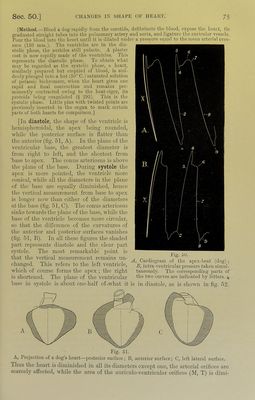
![nished about one-half (lig. 53). This is most important in connection with the closure of the auriculo-ventricular valves j as it shows that the muscular fil^res of the heart, by diminishing these orihces during .systole, greatly aid in the perfect closure of these valves. Thus we explain why defective nutrition of the cardiac mu.scle may give rise to incompetency of these valves, witliout the valves tliem- .selves being diseased {Macalister).'\ [In order to account for the vertical diameter remaining un- changed, we may represent the ventricular liln’es as consisting of three layers, viz., an inner and outer set, more or less longitudinal, and a middle set, circular. Both sets will tend, when they contract, the cavity, but the . . T> * 1 stMS wiu uuir A, aorta; PA, pulmon- . . , ary artery ;M, mitral, to diminish Fig. 52. Projection of tlio base in systole and diastole; RV, ct. . n r i- i right, and LV, left ven- and T tricuspid ori- shortening of the iongitiidmal tiTcle. lice. layers is coiii[:ensated for by the contraction, i.e., the elongation produced by the circular set.] [In order to obtain the shape of the cavities, dogs were taken of the same litter and as nearly alike as possible. One heart was filled with blood, as already described, and placed m a cool solution of potassic bichromate, whereby it was slowly hardened in the diastolic form, while the other was plunged as before into a hot solution. Casts were then made ot the cavities.] 51. THE TIME OF THE CARDIAC MOVEMENTS.—Methods.—The time occupied by the various 'phases of the movements of the heart may be determined by studying the apex-beat we know at what rate the plate on which the curve was obtained moved during the ex- periment, of course all that is necessary is to measure the distance, and so calculate the time occupied by any event (see Pulse, § 67). r •, x- • i .. .-i- (2) It is preferable, however, to cause a tuning-fork, whose rate of vibration is known, to write its vibrations under the curve of the apex-beat (fig. 49, 2), or the curve may be written upon a plate attached to a vibrating tuning-fork (fig. 47, D, E). Such a curve contains fine teeth cau.sed by the vibrations of the tuning-fork. D and E are curves obtained Irom the cardiac impulse in this way from healthy students. In D the notch d is not indicated. Each complete vibration of the tuning-fork, reckoned from apex to apex of the teeth = 0'01613 second, so that it is simp y necessary to count tlie number of teeth and multiply to obtain the tune. The values obtained vary within certain limits even in health. The value of a 5 = pause -t- contraction of the auricles, is subject to the gi-eatest variation, and depends chiefly upon the number of heart-heats [ler minute. The more quickly the heart heats, the shorter is the pause, and conversely. n some curves, even when the heart heats slowly, it is scarcely po.ssihle to distinguis i the auricular contraction (indicated by a rise) from the part of the curve correspom - ing to the pause (indicated by a horizontal line). In one casejheart-bea s pei minute) the piause = 0'4 second, the auricular contraction = 0 li I seconcl. n 47, A, the time occupied by the pause -1- the auricular contraction (l4 lea s 1 ci minute) = 0-5 second. In D, a 5 = 19 to 20 vibrations = 0'32 second; m B = 26 vibrations = 0'42 second. i. + The ventricular systole is calculated from the beginning of the contraction u, to c, Avhen the semi-lunar valves are closed; it lasts from tlie first to the second souiu . It also varies somewhat, hut is more constant. AVhen tlie heart beats rapidly, it is somewhat shorter—during slow action longer. In L = 0'32 second ; in i -- - second ; with 55 heats per minute Landois found it = 0'34, with a very high rate of heating = 0T99 second. AVhen the ventricles beat feebly, they contract more slowly ‘'r reeistering apparatus to the heart of an animal ,pist killed. In lig. 54, horn the lentiiiR o rXbit jus® killed, the slow heart-beats, B, are seen to Inst longest. In cases of enormous](https://iiif.wellcomecollection.org/image/b21981516_0001_0116.jp2/full/800%2C/0/default.jpg)
 No text description is available for this image
 No text description is available for this image
 No text description is available for this image