Volume 1
A text-book of human physiology : including histology and microscopical anatomy : with special reference to the requirements of practical medicine / by L. Landois ; translated from the seventh German edition, with additions, by William Stirling.
- Date:
- 1891
Licence: Public Domain Mark
Credit: A text-book of human physiology : including histology and microscopical anatomy : with special reference to the requirements of practical medicine / by L. Landois ; translated from the seventh German edition, with additions, by William Stirling. Source: Wellcome Collection.
Provider: This material has been provided by the Royal College of Physicians of Edinburgh. The original may be consulted at the Royal College of Physicians of Edinburgh.
122/602 page 82
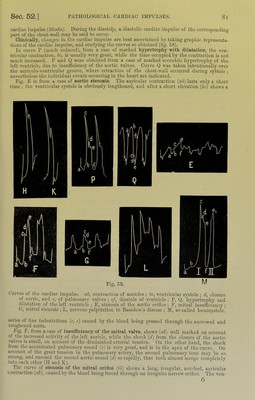
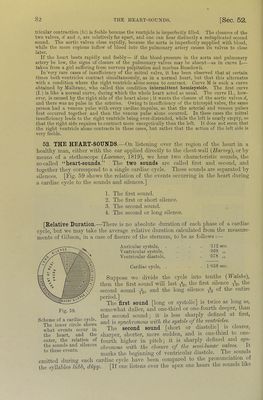
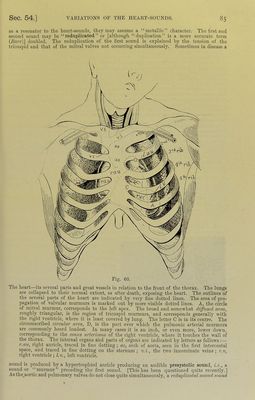
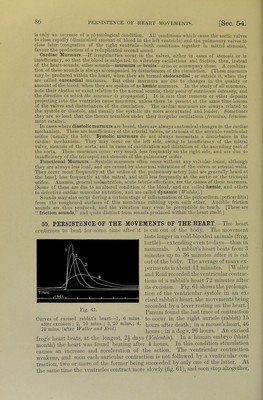
![ti’icular contraction (be) is feeble because tbe ventricle is imperfectly filled. The closures of the two valves, d and c, are relatively far apart, and one can hear distinctly a reduplicated second sound. The aortic valves close rapidly, because the aorta is imperfectly supplied with blood, while the more copious inflow of blood into the pulmonary artery causes its valves to close later. If the heart beats rapidly and feebly— if the blood-pressure in the aorta and pulmonary artery be low, the signs of closure of the pulmonary valves may be absent—as in curve L— taken from a girl sufl'ering from nervous palpitation and morbus Basedowii. In very rare cases of iusutficiency of the mitral valve, it has been observed that at certain times both ventricles contract simultaneously, as in a normal heart, but that this alternates with a condition where the right ventricle alone seems to contract. Curve M is such a curve obtained by Malbranc, who called this condition intermittent hemisystole. The first curve (I.) is like a normal curve, during which the whole heart acted as usual. The curve IL, how- ever, is caused by the right side of the heart alone ; it wants the closure of the aortic valves d, and there was no pulse in the arteries. Owing to insufficiency of the tricuspid valve, the same person had a venous pulse with every cardiac impulse, so that the arterial and venous pulses first occurred together, and then the venous pulse alone occurred. In these cases the mitral insufficiency leads to the right ventricle being over-distended, while the left is nearly empty, so that the right side requires to contract more energetically than the left. It does not seem that the right ventricle alone contracts in these cases, but rather that the action of the left side is very feeble. 53. THE HEART-SOUNDS.—On listening over tlie region of the heart in a healthy man, either with the ear applied directly to the chest-waU {Harvey), or hy means of a stethoscope {Laennec, 1819), we hear two characteristic soimds, the so-called “heart-sounds.” The two sounds are called first and second, and together they correspond to a single cardiac cycle. These sounds are separated hy sdences. [Fig. 59 shows the relation of the events occurring in the heart during a cardiac cycle to the somrds and silences.] 1. The first sound. 2. The first or short silence. 3. The second sound. 4. The second or long silence. [Relative Duration.—There is no absolute duration of each phase of a cardiac cycle, hut we may take the average relative duration calculated from the measure- ments of Gibson, in a case of fissure of the sternum, to he as follows :— Auricular systole. Ventricular sy.stole. Ventricular diastole. Cardiac cycle, . T12 sec. •368 „ ■578 ,, 1 '058 sec. Fig. 59. Suppose we divide the cycle mto tenths (Walslie), then the first soimd will last the first silence the second sound and the long silence of the entire period.] The first sound [long or systolic] is Gvice as long as, somewhat duller, and one-third or one-fourth deeper, than the second sound; it is less sharply defined at first. ^'S'innL'Sk and irsyZhronouswiih the systole of the ventricles. The second sound [short or diastolic] is clearer, sharper, shorter, more sudden, and is one-third to one- fourth higher in pitch; it is shar^^ly defined and syn- chronous loith the closure of the semi-lunar valves. It marks the beginning of ventricular diastole. Tlie sounds emitted during each cardiac cycle have been compared to the pronunciation of the syllables lubb, diipp. [If one listens over the apex one hears the sounds like what events occur in the heart, and the outer, the relation of the sounds and silences to these events.](https://iiif.wellcomecollection.org/image/b21981516_0001_0122.jp2/full/800%2C/0/default.jpg)
 No text description is available for this image
 No text description is available for this image
 No text description is available for this image