Volume 1
A text-book of human physiology : including histology and microscopical anatomy : with special reference to the requirements of practical medicine / by L. Landois ; translated from the seventh German edition, with additions, by William Stirling.
- Date:
- 1891
Licence: Public Domain Mark
Credit: A text-book of human physiology : including histology and microscopical anatomy : with special reference to the requirements of practical medicine / by L. Landois ; translated from the seventh German edition, with additions, by William Stirling. Source: Wellcome Collection.
Provider: This material has been provided by the Royal College of Physicians of Edinburgh. The original may be consulted at the Royal College of Physicians of Edinburgh.
127/602 page 87
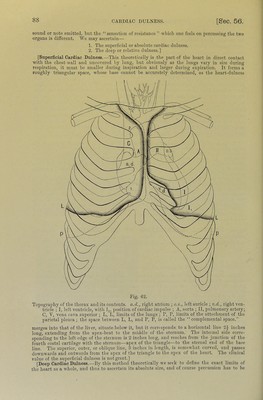
![while the auricles continue to heat. If the ventricles he stimulated directly, as hy iJricking them with a pin, they may execute a contraction. The left auricle soon ceases to beat, while the right auricle still continues to contract. The right auricular appendix continues to beat longest, as was observed by Galen and Car- danus (1550), and it is termed “ultimum moriens.” Similar observations have been made upon the hearts of persons Avho have been executed. If the heart has ceased to beat, it may be excited to contract for a short time by direct stimulation, more especially by heat {Harvey); even under these circum- stances the auricles and their appendices are the last parts to cease contracting. As a general rule, direct stimulation, although it may cause the heart to act more vigorously for a short time, brings it to rest sooner. In such cases, therefore, the regular sequence of events ceases, and there is usually a twitching movement of the muscular hbres of the heart. C. Ludwig found that, even after the excitabihty is extinguished in the mammalian heart, it maybe restored by injecting arterial blood into the coronary arteries: conversely, lesion of these vessels is followed by enfeebled action of the.heart (§ 47). Hammer found that in a man, whose left coronary artery was plugged, the pulse fell from 80 to 8 beats per minute. [The beats of the excised heart of a rabbit gradually decline in force and frequency, the latent period and contraction become longer, and the excitability more obtuse. The duration of a contraction may be '6 sec., the normal being ’3 sec. The beats have often a bigeminal character. An excised heart may be frozen quite hard, yet on being thawed it contracts spontaneously. The contraction proceeds in a wave from the spot stimulated in the frog’s heart, at 8° to 12° C. at 30 to 90 mm. per sec.; in the mammalian excised heart about 8 metres per sec. ( Waller and Reid).'] Action of Gases on the Heart.—During its activity the heart uses 0, and produces COg so that it beats longest in pure 0 (12 hours), and not so long in N,—H (1 hour)—CO2 (10 minutes) —CO (42 minutes)—Cl (2 minutes), or in a vacuum (20 to 30 minutes), even when there is watery vapour present to prevent evaporation. If the heart be reintroduced into 0 it begins to beat again. [Gases seem to have the same effect in the chick’s heart on the second and third days of incubation as in the adult heart {Fano). A frog’s heart ceases to beat in compressed 0 (10 to 12 atmospheres) in about one-third of the time it would do were it simply excised and left to itself. An excised heart suspended in ordinary air beats three to four times as long as a heart which is placed upon a glass-plate. ] [56. PHYSICAL EXAMINATION OF THE HEART.—The physical methods of diagnosis enable ns to obtain precise knowledge regarding the actual state of the heart. The methods available are :— [Inspection.—The person is supposed to have his chest exposed apd to be in the recumbent position. It is important to remember the limits of the heart. The base corresponds to a line joining the upper margins of the third costal cartilages, the apex to the fifth interspace, while transversely it extends from a little to the right of the sternum to within a little of the left nipple ; this area occupied by the heart being called the deep cardiac region (fig. 62). By the eye we can detect any alteration in the configuration of the prrecordia, bulging or retraction of the region as a whole or of the intercostal spaces, and we may detect variations in the position, character, extent of the cardiac impulse, or the presence of other visible pulsations.] [Palpation.—By placing the whole hand flat upon the proecordia, we can ascertain the presence or absence, the situation and extent, and any alterations in the characters of the apex- beat ; or we may detect the existence of abnormal pulsations, vibrations, thrills, or friction in tliis region. In feeling for the apex-beat, if it be at all feeble, it is well to make the patient lean forward. Of course, it must be remembered that the whole heart may be displaced by tumours or accumulations of lluids pressing upon it, i.e., conditions external to itself, or the apex-beat may be displaced from causes within the heart itself, as in hypertrophy of the left ventricle.] [Percussion.—As the heart is a solid organ, and is surrounded by the lungs, which contain air, it is evident that the sound emitted by striking the chest over the region of the former must be different from that produced over the latter. Not only is there a difference in the 1. Inspection. 2. Palpation. 3. Percussion. 4. Auscultation. To arrive at a correct diagnosis all tlie metliods must be employed.]](https://iiif.wellcomecollection.org/image/b21981516_0001_0127.jp2/full/800%2C/0/default.jpg)
 No text description is available for this image
 No text description is available for this image
 No text description is available for this image