Volume 1
A text-book of human physiology : including histology and microscopical anatomy : with special reference to the requirements of practical medicine / by L. Landois ; translated from the seventh German edition, with additions, by William Stirling.
- Date:
- 1891
Licence: Public Domain Mark
Credit: A text-book of human physiology : including histology and microscopical anatomy : with special reference to the requirements of practical medicine / by L. Landois ; translated from the seventh German edition, with additions, by William Stirling. Source: Wellcome Collection.
Provider: This material has been provided by the Royal College of Physicians of Edinburgh. The original may be consulted at the Royal College of Physicians of Edinburgh.
132/602 page 92
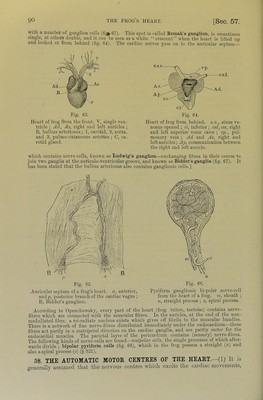
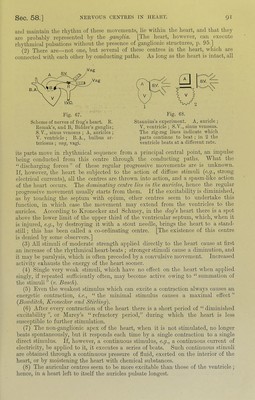
![(9) The heart may he excited (reflexly) from its inner surface. Weak stimuli applied to the inner surface of the heai’t greatly accelerate the heart’s action, the stimulus retpiired being much feebler than that applied to the external surface of the heart. Strong stimuli, which bring the heart to rest, also act more easily when ajrplied to its inner surface than when they are applied to its outer surface. The ventricle is always the first part to be jjaralysed. (10) In order that the heart may continue to contract, it is necessary that it be sujiplied with a fluid which, in addition to O, must contain the necessary nutritive materials. The most perfect fluid, of course, is blood. Hence the heart after a time ceases to beat in an indifferent fluid (0'6 per cent, sodium chloride), hut its activity may he revived by supplying it Avith a proirer nutritive fluid. Cardiac Nutritive Fluids.—These iintritivo Iluids are such as contain serum-albumin, c.g., blood, serum, or lymph. Serum retains its nutritive properties even after it has been subjected to diffusion {Martins and Krunecker). Milk and whey {v. Ott), normal saline solution mixed with blood, albumin, or peptone, and 0’3 irer cent, sodium carbonate {Kroncckcr, Merunowicz and StUnon), a trace of caustic soda {Gaule), or a solution of the salts of serum, are suitable. Alka- line solution of soda revives a feebly beating heart by neutralising the acid formed in the cardiac muscle, and so does normal saline containing calcic phosphate and potassic chloride {S. Ringer). (11) The independent pulsations of parts of the heart which are devoid of ganglia show that the presence of gangha is not absolutely neeessary in order to have rhythmical prdsation. Direct stimulation of the heart may cause these move- ments. But the ganglia are more excitable than the heart muscle itself, and they conduct the impulses which lead to the regular alternating action of the various parts of the heart, so that, under normal eircum stances, we must assmne that the action of the heart is governed by the ganglia. (12) If a heart be cut in pieces, so that the individual pieces still remain connected with each other, the regular peristaltic or wave-hke movements proceeding from the auricles to the ventricle may continue for a long time {Danders, Enyelmann). If the heart, however, be completely divided into two distinct pieces ^auricle and ventricle), the movements of both parts continue, but not in the same sequence—they beat at different rates. The chief experiments upon which the above statements are based are as folloAvs :— I. Experiments by cutting and ligaturing the heart. These experiments have been made chiefly upon the heart of the frog. The ligature experiments are per- formed by tightening and then relaxing a ligature placed around the heart, so that the physiological connection is destroyed, Avhile the anatomical or mechanical con- nections (continuity of the cardiac wall, intact condition of its cavities) still exist. The most important of these experiments are— (1) Stannius’s Experiment.—If the sinus venosus of a frog’s heart be separated from the auricles, either by an incision or by a ligature, the auricles and ventricle stand still in diastole, Avhilst the veins and the remainder of the sinus continue to beat (fig. 68, 1). If a second incision be made at the auriculo-A^entricular grooA'e, as a rule the A^entricle begins at once to beat again, Avhilst the auricles remain in the condition of diastolic rest. [Thus the sinus venosus and ventricle continue to beat, Avhile the auricle stands still, but the tAvo former no longer beat A*vith the same rhythm, the ventricle usually beats more sloAvly, as is shoAvn in fig. 68, 2, by the large zig-zags.] According to the position of the second ligature or incision, the auricles may also beat along Avith the ventricles, or the auricles alone may beat Avhile the ventricles remain at rest. Theoretical.—Various explanations of these experiments have been given :—(A) Eeniak’s ganglion in the sinus venosus is distinguislied by its great excitability, Avhile Bidder’s ganglion in the auriculo-ventricular groove is less excitable ; in the normal condition of the heart the motor impulse is carried from the former to the latter. If the sinus venosus be separated from the heart, Remak’s ganglion has no action on the heart. The heart stops for two reasons—](https://iiif.wellcomecollection.org/image/b21981516_0001_0132.jp2/full/800%2C/0/default.jpg)
 No text description is available for this image
 No text description is available for this image
 No text description is available for this image