Volume 1
A text-book of human physiology : including histology and microscopical anatomy : with special reference to the requirements of practical medicine / by L. Landois ; translated from the seventh German edition, with additions, by William Stirling.
- Date:
- 1891
Licence: Public Domain Mark
Credit: A text-book of human physiology : including histology and microscopical anatomy : with special reference to the requirements of practical medicine / by L. Landois ; translated from the seventh German edition, with additions, by William Stirling. Source: Wellcome Collection.
Provider: This material has been provided by the Royal College of Physicians of Edinburgh. The original may be consulted at the Royal College of Physicians of Edinburgh.
134/602 page 94
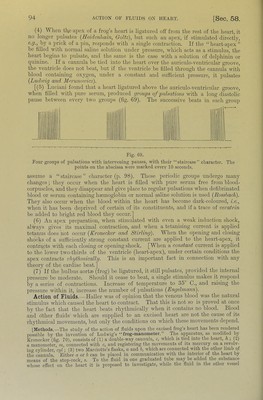
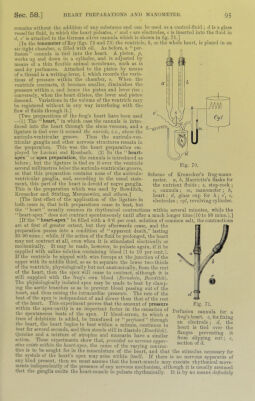
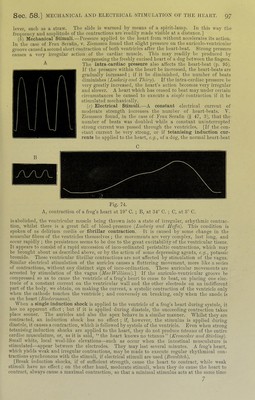
![(4) Wlieii tl^e .apc-x of a frog’s heart is ligatured off from tlie rest of the lieart, it no longer pulsates [Fleidonhain, Golta), but such an apex, if stimulated directl}', A l>rick of a pin, responds with a single contraction. If the “heart-apex” be filled with normal saline solution under pressure, which acts as a stimuhrs, the heart begins to pulsate, and the same is the case with a solution of delphinin or quinine. If a cannula be tied into the heart over the auriculo-ventricular groove, the ventricle does not beat, but if the ventricle be filled through the cannula with blood containing oxygen, under a constant and sufficient pressure, it pulsates {Ludwig and Mp.runowicz). [(5) Luciani found that a heart ligatured above the auriculo-ventricular groove, when filled with pure serum, produced groups of pulsations with a long diastolic pause between every two groups (fig. 69). The successive beats in each group Fig. 69. Four groups of pulsations with iutervening pauses, with their “staircase” character. The points on the abscissa were marked every 10 seconds. assume a “staircase” character (p. 98). These periodic groups undergo many changes; they occur when the heart is filled with pure serum free from blood- corpuscles, and they disappear and give place to regular pulsations when defibrinated blood or serum contaming haemoglobin or normal saline solution is used {Rosshach). They also occur when the blood within the heart has become dark-coloured, i.e., when it has been deprived of certain of its constituents, and if a trace of veratrin be added to bright red blood they occur.] (6) An apex preparation, when stimulated with even a weak induction shock, always gives its maximal contraction, and when a tetanising current is apphed tetanus does not occur {Kronecker and Stirling). When the opening and closing shocks of a sufficiently strong constant current are applied to the heart-apex, it contracts with each closing or opening shock. [When a constant current is apj)lied to the lower two-thirds of the ventricle (heart-apex), under certain conditions the apex contracts rhythmically. This is an important fact in connection with any theory of the cardiac beat.] (7) If the bulbus aortse (frog) be ligatured, it still pulsates, provided the internal pressure be moderate. Should it cease to beat, a single stimulus makes it respond by a series of contractions. Increase of temperature to 35 C., and raising the pressure within it, increase the number of pulsations {Engelmann). Action of Fluids.—Haller was of opinion that the venous blood was the natural stimulus which caused the heart to contract. That this is not so is proved at once by the fact that the heart beats rhythmically Avhen it contains no blood. Blood and other fluids which are supplied to an excised heart are not the cause of its rhythmical movements, but only the conditions on which these movements depend. [Methods.—The study of the action of fluids upon the excised frog’s heart lias been rendered possible by the invention of Ludwig’s “frog-manometer.” The apparatus, as modified by Kronecker (fig. 70), consists of (1) a double-way cannula, c, which is tied into the heart, h ; (2) a manometer, m, connected with c, and registering the movements of its mercury on a revolv- ing cylinder, cyt; (3) two Marriotte’s flasks, a and h, which are connected with the other limb of the cannula. Either a or h can be placed in communication with the interior of the heart by means of the stop-cock, s. To the fluid in one graduated tube may be added the substance whose effect on the heart it is proposed to investigate, while the fluid in the other vessel](https://iiif.wellcomecollection.org/image/b21981516_0001_0134.jp2/full/800%2C/0/default.jpg)
 No text description is available for this image
 No text description is available for this image
 No text description is available for this image