Volume 1
A text-book of human physiology : including histology and microscopical anatomy : with special reference to the requirements of practical medicine / by L. Landois ; translated from the seventh German edition, with additions, by William Stirling.
- Date:
- 1891
Licence: Public Domain Mark
Credit: A text-book of human physiology : including histology and microscopical anatomy : with special reference to the requirements of practical medicine / by L. Landois ; translated from the seventh German edition, with additions, by William Stirling. Source: Wellcome Collection.
Provider: This material has been provided by the Royal College of Physicians of Edinburgh. The original may be consulted at the Royal College of Physicians of Edinburgh.
163/602 page 123
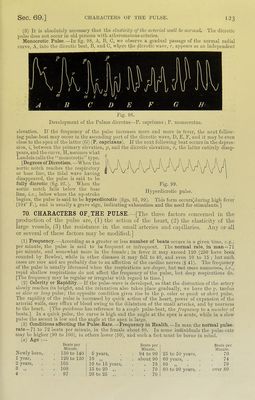
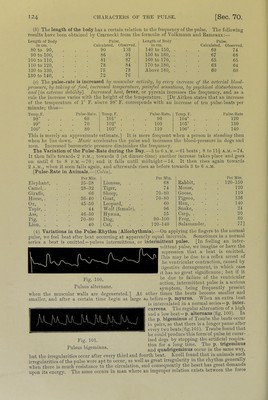
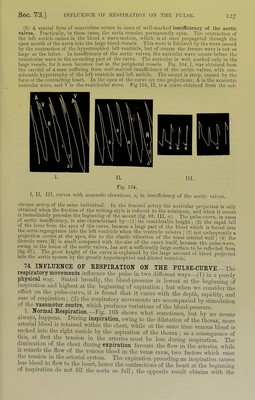
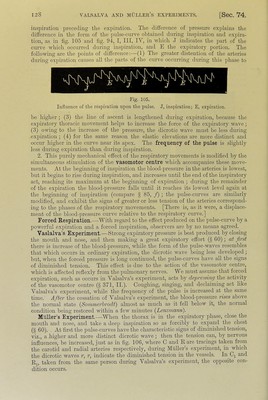
![(3) It is absolutely necessary that the elaslicUy of the arterial ‘wall he normal. The dicrotic pulse does not occur in old persons with atheromatous arteries. Monocrotic Pulse.—In fig. 98, A, B, C, wo observe a gradual passage of the normal radial curve. A, into the dicrotic beat, B, and C, wl\ere the dicrotic wave, r, ap])ears as an independent Fig. 98. Development of the Pulsus dicrotus—P. caprizans:; P. monocrotus. elevation. If the frequency of the pulse increases more and more in fever, the next follow- ing pulse-beat may occur in the ascending part of the dicrotic wave, D, E, F, and it may be even close to the apex of the latter (G) (P. caprizans). If the next following sion, i, between the primary elevation, p, and the dicrotic elevation, r, pears, and the curve, H, assumes what Landois calls the “monocrotic” type. [Degrees of Dicrotism.—When the aortic notch reaches the respiratory or base line, the tidal wave having disappeared, the pulse is said to be beat occurs in the depres- the latter entirely disap- fully dicrotic (fig. 95.). When the Fig. 99. Hyperdicrotic pulse. aortic notch falls below the base line, i.e., below where the up-stroke begins, the jiulse is said to be hyperdicrotic (figs. 95, 99). (101° F.), and is usually a grave sign, indicating exhaustion and the need for'stimuiauts.] This form occurslduriug high fever 70. CHARACTERS OF^THE PULSE.—[The three factors concerned in the production of the pulse are, (1) the action of the heart, (2) the elasticity of the large vessels, (3) the resistance in the small arteries and capillaries. Any or all or several of these factors may he modified.] (1) Frequency.—According as a greater or less number of beats occurs in a given time, e.g., per minute, the pulse is said to be frequent or infrequent. The normal rate, in man=71 per minute, and somewhat more in the female ; in fever it may exceed 120 (250 have been counted by Bowles), while in other diseases it may fall to 40, and even 10 to 15 ; but such ca.ses are rare and are probably due to an affection of the cardiac nerves (§ 41). The frequency of the pidse is usually iricrcased Avhen the respirations are deeper, but not more numerous, i.c., ra|)id shallow respirations do not affect the frequency of the pulse, but deep respirations do. [The frequency may be regular or irregular with regard to time.] (2) Celerity or Kapidity. - If the pulse-wave is develojied, so that the distention of the artery slowly reaches its height, and the relaxation also takes place gradually, we have the ]>. tardus or sfoty or pulse; the opposite condition gives rise to the p. celer ov quick ov short pulse. The rapidity of the ]iulse is increased by quick action of the heart, power of expansion of the arterial walls, easy efflux of blood owing to the dilatation of the small arteries, and by nearness to the heart. [The quick7iess has reference to a single pulse-bent, the frequency to a number of beats.] In a quick jrulse, the curve is high and the angle at the apex is acute, while in a slow pulse the ascent is low and the angle at the apex is large. (3) Conditions affecting the Pulse-Rate.—Frequency in Health.—In man the normal pulse- rate = 71 to 72 beats per minute, in the female about 80. In some individuals the pulse-rate may be higher (90 to 100), in others lower (50), and such a fact must be borne in mind. (a) Age Newly boni. Beats per Minute. . 130 to 140 5 years. Beats per Minute. . 94 to 90 25 to 50 years. Beats jier Minute. 70 1 year. . 120 to 130 10 „ . about 90 60 years, . 74 2 vears, . 105 10 to 15 years. . 78 80 „ . 79 3 ., . 100 15 to 20 ,, . 70 80 to 90 years, . ov'or 80 4 . 97 20 to 25 . 70](https://iiif.wellcomecollection.org/image/b21981516_0001_0163.jp2/full/800%2C/0/default.jpg)
 No text description is available for this image
 No text description is available for this image
 No text description is available for this image