Volume 1
A text-book of human physiology : including histology and microscopical anatomy : with special reference to the requirements of practical medicine / by L. Landois ; translated from the seventh German edition, with additions, by William Stirling.
- Date:
- 1891
Licence: Public Domain Mark
Credit: A text-book of human physiology : including histology and microscopical anatomy : with special reference to the requirements of practical medicine / by L. Landois ; translated from the seventh German edition, with additions, by William Stirling. Source: Wellcome Collection.
Provider: This material has been provided by the Royal College of Physicians of Edinburgh. The original may be consulted at the Royal College of Physicians of Edinburgh.
182/602 page 142
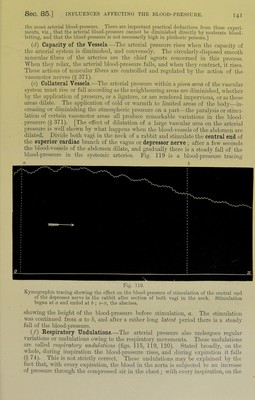
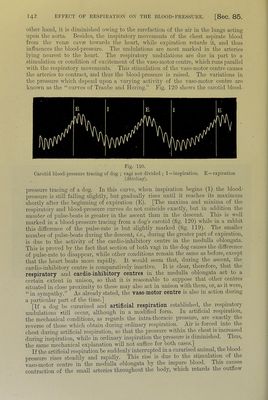
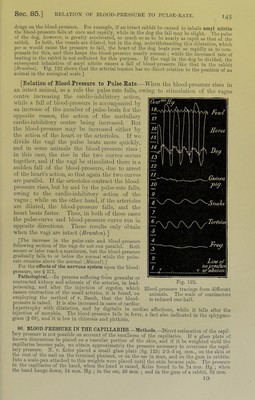
![other hand, it is diminished owing to the rarefaction of the air in the lungs acting npon the aorta. Besides, the inspiratory movements of the chest aspirate Ijlood from the vente cavJB towards the heart, while expiration retards it, and thus influences the blood-pressure. The undulations are most marked in the arteries lying nearest to the heart. The respiratory undulations are due in part to a stimulation or condition of excitement of the vaso-motor centre, which runs parallel with the respiratory movements. This stimulation of the vaso-motor centre causes the arteries to contract, and thus the blood-pressure is raised. The variations in the pressure which depend npon a varying activity of the vaso-motor centre are known as the “curves of Tranbe and Hering.” Fig. 120 shows the carotid blood- Fig. 120. Carotid blood-pressure tracing of dog ; vagi not divided ; I = iuspii’atiou. E = expiration {Stirling). pressure tracing of a dog. In this curve, when insj)iration begins (1) the blood- pressure is stiU falling slightly, but gradually rises imtil it reaches its maximum shortly after the beginning of expiration (E). [The maxima and minima of the respiratory and blood-pressure curves do not coincide exactly, but in addition the number of pulse-beats is greater in the ascent than in the descent. This is well marked in a blood-pressure tracing from a dog’s carotid (fig. 120) whde in a rabbit this difference of the pulse-rate is but slightly marked (fig. 119). The smaller number of pulse-beats during the descent, i.e., during the greater part of expiration, is due to the activity of the cardio-inhibitory centre in the medrdla oblongata. This is proved by the fact that section of both vagi in the dog causes the difference of pulse-rate to disappear, while other conditions remain the same as before, except that the heart beats more rapidly. It would seem that, during the ascent, the cardio-inhibitory centre is comparatively inactive. It is clear, therefore, that the respiratory and cardio-inhibitory centres m the medulla oblongata act to a certain extent in unison, so that it is reasonable to suppose that other centres situated in close proximity to these may also act in unison with them, or, as it were, “ in sympathy.” As already stated, the vaso-motor centre is also in action during a particular part of the time.] [If a dog be curarised and artificial respiration established,^ the respmatory undulations still occur, although in a modified form. In artificial respiiation, the mechanical conditions, as regards the intra-thoracic pressure, are exactly the reverse of those which obtain during ordinary respiration. Air is forced mto the chest durmg artificial respiration, so that the pressure within the chest is mcreased during inspiration, while in ordinary inspiration the pressure is dimuiished. Thus, the same mechanical explanation will not suffice for both cases.] If the artificial respiration be suddenly interrupted in a curarised animal, the blood- pressure rises steadily and rapidly. This rise is due to the stimulation of the vaso-motor centre in the medulla oblongata by the impure blood. This causes contraction of the small arteries throughout the body, which retards the outflow](https://iiif.wellcomecollection.org/image/b21981516_0001_0182.jp2/full/800%2C/0/default.jpg)
 No text description is available for this image
 No text description is available for this image
 No text description is available for this image