Volume 1
A text-book of human physiology : including histology and microscopical anatomy : with special reference to the requirements of practical medicine / by L. Landois ; translated from the seventh German edition, with additions, by William Stirling.
- Date:
- 1891
Licence: Public Domain Mark
Credit: A text-book of human physiology : including histology and microscopical anatomy : with special reference to the requirements of practical medicine / by L. Landois ; translated from the seventh German edition, with additions, by William Stirling. Source: Wellcome Collection.
Provider: This material has been provided by the Royal College of Physicians of Edinburgh. The original may be consulted at the Royal College of Physicians of Edinburgh.
193/602 page 153
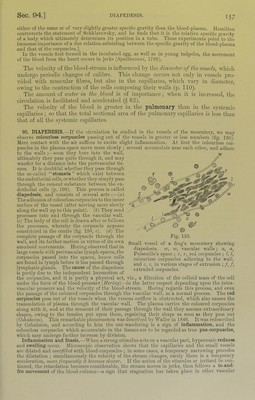
![of the circulatory system, through tlic ]m]monic as well as through the systemic circulation, so that the same amount of hlood must pass through the jmlmonary artery and aorta, notwithstanding the very unequal blood-pressure in these two vessels. (3) Lumen or Sectional Area.—The velocitj'^ of the current, therefore, in various sections of the Amssels, must be inversely as their sectional area. (4) Capillaries.—Hence the velocity must diminish very considerably as Ave pass from the root of the aorta and the pul- monary artery towards the capillaries, so that the velocity in the capillaries of mammals = 0'8 millimetre per sec. ; frog = 0'53; man = 0'6to0'9 mm. [average 2 inches per minute]. According to A. W. Volkmann, the blood in mammalian capillaries floAA^s 500 times sloAver than the blood in the aorta, so that the total sectional area of all the capillaries must be 500 times greater than that of the aorta. Donders found the A^elocity of the stream in the small afferent arteries to be 10 times faster than in the capillaries. Veins.—The current becomes accelerated in the Amins, but in the larger trunks it is Fig. 129. Scheme of the sectional area. A, arterial, and V, venous orifice. The common iliacs are an exception ; the sum of their sectional areas is less than tliat of the aorta ; the sections of the four pul- monary veins are together less than that of the pulmonary artery. blood-pressure, so that it may be 0'5 to 0 75 times less than in the correspond- ing arteries. (5) Mean Blood-Pressure.—The velocity of the blood, does not depend upon the mean the same in congested and in anaemic parts. (6) Difference of Pressure.—On the other hand, the Amlocity in any section of a vessel is dependent on the difference of the pressure Avhich exists at the com- mencement and at the end of that particular section of a blood-Amssel; it depends, therefore, on (1) the vis a tergo (f.e., the action of the heart), and (2) on the amount of the resistance at the periphery (dilatation or contraction of the small vessels). CoiTcsponding to the smaller difference in the arterial and venous pressure iu the foetus (§ 85), the velocity of the blood is less in this case {Cohnstcin and Ziinlz). (7) Pulsatory Acceleration.—With euery a corresponding acceleration of the blood-current (as AveU as of the blood-pressure) takes place in the arteries (pp. 144, 151). In large vessels Vierordt found the increase of the velocity during the systole to be greater by to \ than the Amlocity during the diastole. The variations in the velocity caused by the heart-beat are recorded in fig. 127, III, oljtained Ijy Chauveau’s dromograph from the carotid of a horse. The velocity curve corresponds Avith a spliygmogram—P represents the priinary eleA^ation and K the dicrotic Avave. This acceleration, as Avell as the pulse, disappears in the cajiillaries. A pulsatory acceleration, more rapid during its first phase, is observable in the small arteries, although the arteries themselves are not distended thereby. (8) Respiratory Effect.—Every inspiration retards the velocity in the arteries, every expAration aids it someAvhat; but the value of these agencies is very small. If we compare what lias already been said regarding the efl'ect of the respiration ou the eou- tractiou and dilatation of the heart and ou the blood-stream (§ 60), it is clear that respiration favours the blood-stream, and so does artificial respiration. When artificial respiration is inter- rupted, the blood-stream becomes slower {Dogicl). If the suspension of respiration lasts some- what longer, the current is again aecelerated on account of the dyspuocic stimulation of the va.so-motor centre {llcidenhain) (§ 371, I.). (9) Modifying Conditions.—Many circum.stanco.s affect the velocity of the blood in the A'eims. There are regidar variatioms in the large vcin-s near the heart](https://iiif.wellcomecollection.org/image/b21981516_0001_0193.jp2/full/800%2C/0/default.jpg)
 No text description is available for this image
 No text description is available for this image
 No text description is available for this image