Volume 1
A text-book of human physiology : including histology and microscopical anatomy : with special reference to the requirements of practical medicine / by L. Landois ; translated from the seventh German edition, with additions, by William Stirling.
- Date:
- 1891
Licence: Public Domain Mark
Credit: A text-book of human physiology : including histology and microscopical anatomy : with special reference to the requirements of practical medicine / by L. Landois ; translated from the seventh German edition, with additions, by William Stirling. Source: Wellcome Collection.
Provider: This material has been provided by the Royal College of Physicians of Edinburgh. The original may be consulted at the Royal College of Physicians of Edinburgh.
215/602 page 175
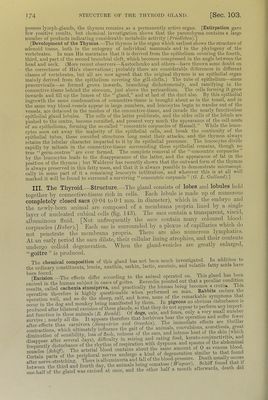
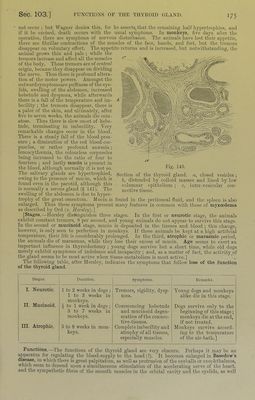
![not omir ; but AVagiier denies this, for be asserts, that the rcmiiiiiiiig lialf hypertroiihies, and if it be e.xcised, death occurs with the usual symjitoms. In monkeys, live days after tlie operation, there are symptoms of nervous disturbance. The animals have lo.st their a]>petite, there are fibrillar contractions of the muscles of the face, hands, and feet, but the tretnors disappear on voluntary effort. The appetite returns and is increased, but notwithstanding, the aidmal grows thin and pale ; while the tremors increase and affect all the muscles of the body. These tremors are of central origin, because they disappear on dividing the nerve. Thus there is profound altera- tion of tlie motor powers. Amongst the outward symptoms are jnifliness of the eye- lids, swelling of the abdomen, increased hebetude and dyspnoea, while afterwards there is a fall of the temjierature and im- becility ; the tremors disajipear, there is a palor of the skin, and ultimately, after five to seven weeks, the animals die com- atose. Thus there is slow onset of hebe- tude, terminating in imbecility. Very remarkable changes occur in the blood. There is a steady fall of the blood-pres- sure ; a diminution of the red blood-cor- puscles, or rather profound antemia; leucocythtemia, the colourless corjjuscles being increased to the ratio of four to fourteen ; and lastly mucin is present in the blood, although normally it is not so. The salivary glands are hyjiertrophied, ovving to the presence of mucin, which is found even in the parotid, although this is normally a serous gland (§ 141). The swelling of the abdomen is due to hyper- trophy of the great omentum. M ucin is found in the peritoneal fluid, and the spleen is also enlarged. Thus these symptoms j)resent many features in common with those of myxoedema as described by Ord {v. Horsley).'\ [Stages.—Horsley distinguishes three stages. In the first or neurotic stage, the animals exhibit constant tremors, 8 per second, and young animals do not appear to survive this stage. In the second or mucinoid stage, mucin is deposited in the tissues and blood ; this change, however, is only seen to perfection in monkeys. If these animals be kejit at a high artificial temperature, their life is considerably prolonged. In the third, atrophic or marasmic period, the animals die of marasmus, while they lose their excess of mucin. Age seems to exert an important influence in thyroidectomy ; young dogs survive but a short time, while old dogs merely exhibit symptoms of indolence and incapacity ; and, as a matter of fact, the activity of the gland seems to be most active when tissue-metabolism is most active.] The following table, after Horsley, indicates the symptoms that follow loss of the function of the thyroid gland. Fig. 143. Section of the thyroid gland. «, closed vesicles ; h, distended by colloid ma.sses and lined by low columnar epithelium ; c, inter-vesicular con- nective tissue. Stages. Duration. Symptoms. Remarks. I. I Neurotic. 1 to 2 weeks in dogs ; 1 to 3 weeks in monkeys. Tremors, rigidity, dysp- noea. Young dogs and monkeys alike die in this stage. 1 1 Mucinoid. J to 1 week in dogs ; 3 to 7 weeks in monkeys. Commencing hebetude and mucinoid degen- eration of the connec- tive-tis.sues. Dogs survive only to the beginning of this stage; monkeys die at the end, if not treated. III. Atrophic. 5 to 8 weeks in mon- keys. Com])lete imbecility and atrojihy of all tissues, especially muscles. Monkeys survive accord- ing to the temperature of the air-bath.] Functions.—'I’he functions of the thyroid gland are very obscure. Perhaps it may bo an apparatus for regulating the blood-supply to the head(?). It becomes eidarged in Basedow’s disease, in which there is great palpitation, as well as jirotrusion of the eyelialls or exophthalmos, which seem to de[)cnd upon a simultaneous stimulation of the accelerating nerve of the heart, and the sympathetic fibres of the smooth muscles in the orbital cavity and the eyelids, as well](https://iiif.wellcomecollection.org/image/b21981516_0001_0215.jp2/full/800%2C/0/default.jpg)
 No text description is available for this image
 No text description is available for this image
 No text description is available for this image