Volume 1
A text-book of human physiology : including histology and microscopical anatomy : with special reference to the requirements of practical medicine / by L. Landois ; translated from the seventh German edition, with additions, by William Stirling.
- Date:
- 1891
Licence: Public Domain Mark
Credit: A text-book of human physiology : including histology and microscopical anatomy : with special reference to the requirements of practical medicine / by L. Landois ; translated from the seventh German edition, with additions, by William Stirling. Source: Wellcome Collection.
Provider: This material has been provided by the Royal College of Physicians of Edinburgh. The original may be consulted at the Royal College of Physicians of Edinburgh.
216/602 page 176
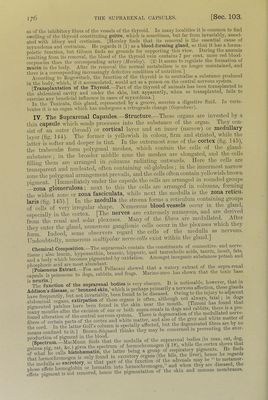
![as of the inhibitory iibrcs of the vessels of the thyroid. In many localitie.s it i.s common to find swelling of the thyroid constituting goitre, which is sometimes, but lar from invariably, associ- ated with idiocy and cretinism. [Horsley finds tliat its removal is the essential cause of niyxcedema and eretinism. He regards it (1) as a blood-forming gland, so that it ha,s a Inema- poietic function, but Gibson finds no grounds for snpportiug this view. During the anemia resultino- from its removal, the blood of the thyroid vein contains 7 per cent, more red blood- corpnscles than the corresponding artery [Horsley). (2) It seems to regulate the formation of mucin in the body. After its removal the normal metabolism is no longer maintained, and there is a corresponding increasingly defective condition of nutrition.] According to Rogowitsch, the function of the thyroid is to neutralise a substance produced in the body which, if it accumulated, would act as a poison on the central nervous system. [Transplantation of the Thyroid.—Part of the thyroid of animals has been transplanted to the abdominal cavity and under the skin, but apparently, when so transplanted, fails to exercise any beneficial influence in oases of niyxcedema.] In the Tunicata, this gland, represented by a groove, secretes a digestive fluid, in verte- brates it is an organ which has undergone a reti'ograde change [Gegenhaur). IV. The Suprarenal Capsules.—Structure.—These organs are invested by a thin capsule which sends processes into the substance of the organ. They con- sist of an outer (broad) or cortical layer and an inner (narrow) or medullary layer (fig. 144). The former is yellowish in colour, firm and striated, while the latter is softer and deeper in tint. In the outermost zone of the cortex (fig. 14-5), the trabeculffi form polygonal meshes, which contain the cells of the gland- substance ; in the broader middle zone the meshes are elongated, and the cells filliim them are arranged in columns radiating outwards. Here the ceUs are transparent and nucleated, often containing oil-globules; in the innermost narrow zone the polygonal arrangement prevails, and the ceUs often contain yeUowish-brown nio'ment. [Immediately under the capside the cells are arranged in rounded groups —^ona glomerulosa; next to this the cells are arranged in columns, forming the widest zone or zona fasciculata, while next the medulla is the zona reticu- laris (fio- 145) 1 In the medulla the stroma forms a reticulum containing groups of ceUs° of very irregular shape. Numerous blood-vessels occur in the gland esnecially in the cortex. [The nerves are extremely numerous, and are derived from the renal and solar plexuses. Many of the fibres are nieduUated. After they enter the gland, numerous gaughonic cells occur in the plexuses ivliich they form. Indeed, some observers regard the cells of the medulla as nervous. Undoubtedly, numerous multipolar nerve-cells exist within the gland.J Chemical Composition.—The siiprareiials contain the constituents of _coniiectn'e-_and iimwe- tissiie • also leucin, hypoxanthin, benzoic, hippunc, and taurochohe acids, taiinn, luosit, fats, and a body which becomes pigmented by oxidation. Amongst inorganic substances potash and showed that a watery extract of the supra-mial ca&“^^^^ to dogs, rabbits, and frogs. Marino-zuco has shown that the toxic base The^unction of the suprarenal bodies is very obscure. It is noticeable, however, that m AddiBon'e dieease ov ‘bronzed skin,’ which is perhai.s primarily a nervmis affection, these glands me.rL«™d tVft] Brow,.-Sd<i«a,,l tllinks the, may be co.iccmcd ... prc.entmg theovc- 'TSlnmhfSnm the med.illa of the s.iptarenal brfte (in ...... cat dog ^ ^ TiUr vit 1 ffives the spectrum of liEeniochroniogen (§ 18), while the coitex sliovs that fMXrfie caib ^ the latter being a group of respiiiitory ftat brnmoohromogen is only fonnd i.. '“'ff,? X™ ml) bf-^o .1, tonor- T irbratr .. E,..S,So;).‘'Urw£ 4- - d-ased, the the pigme.,tatio., of the .skin and mueo... membranes.](https://iiif.wellcomecollection.org/image/b21981516_0001_0216.jp2/full/800%2C/0/default.jpg)
 No text description is available for this image
 No text description is available for this image
 No text description is available for this image