Volume 1
A text-book of human physiology : including histology and microscopical anatomy : with special reference to the requirements of practical medicine / by L. Landois ; translated from the seventh German edition, with additions, by William Stirling.
- Date:
- 1891
Licence: Public Domain Mark
Credit: A text-book of human physiology : including histology and microscopical anatomy : with special reference to the requirements of practical medicine / by L. Landois ; translated from the seventh German edition, with additions, by William Stirling. Source: Wellcome Collection.
Provider: This material has been provided by the Royal College of Physicians of Edinburgh. The original may be consulted at the Royal College of Physicians of Edinburgh.
217/602 page 177
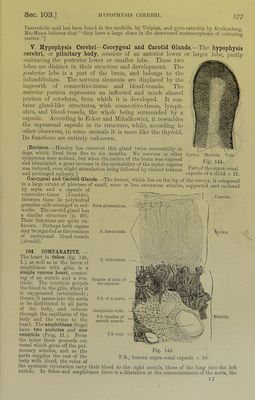
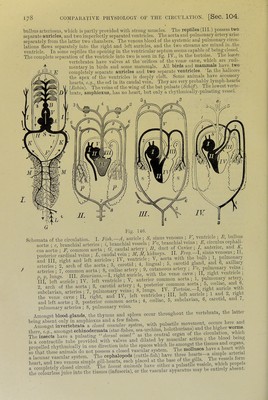
!['riuu'ooholio acid has been found in the medulla by Vulpiau, and pyro-catechin by Krnkenber. MacMnnn believes that “ they have a large share in the downward metamorphosis of colouring matter.”] V. Hypophysis Cerebri^—Coccygeal and Carotid Glands.—The hypophysis cerebri, or pituitary body, consists of an anterior lower or larger lobe, partly embracing the posterior lower or smaller lobe. Tliese two lobes are distinct in their structure and development. The posteno)' lobe is a ]iart of the brain, and belongs to tlie infundibulum. The nervous elements are displaced by the ingrowth of connective-tissue and blood-vessels. The anterior portion represents an inflected and mucli altered portion of ectoderm, from which it is developed. It con- tains gland-like structures, witli connective-tissue, lymph- atics, and blood-vessels, the whole being surrounded by a capsule. According to Ecker and Mihalkowicz, it resembles the suprarenal capsule in its structure, while, according to other observers, in some animals it is more like the thyroid. Its functions are entirely unknown. [Excision.—Horsley has removed this gland twice successfullj’ in dogs, which lived from five to six months. No nervous or other symptoms were noticed, but when the cortex of the brain was exposed and stimulated, a gi-eat increase in the excitability of the motor regions was induced, even slight stimulation being followed by violent tetanus and prolonged epilepsy. ] Coccygeal and Carotid Glands.—The former, which lies on the tip of to a large extent of plexuses of small, more or less cavernous arteries, by septa and a capsule of connective-tissue {Luschka). Between tliese lie polyhedral gi'anular cells arranged in net- works. The carotid gland has a similar structure (p. 90). Their functions are quite un- known. Perhaps both organs may be regarded as the remains of embryonal blood-vessels {Arnold), Cortex. Jledulla. Vein. Fig. 144. Part of the supra-renal capsule of a child x 15. the coccyx, is composed supported and enclosed Zona glomenilosa. Z. fasciculata. Z. reticularis. .Strands of cells of the marrow. T.S. of a nerve. Ganglionic cells. T.S. Inmdles of smooth muscle. T.S.vein. ortex. 104. COMPARATIVE. — The heart in fishes (fig. 146, I.), as well as in the larvte of amphibians with gills, is a simple venous heart, consist- ing of an auricle and a ven- tricle. The ventricle propels the blood to the gills, where it is oxygenated (arterialised); thence it passes into the aorta to be distributed to all parts of the body, and retui’iis through the capillaries of the body and the veins to the heart. The amphibians (frogs) have two auricles and one ventricle (Frog, II.). From the latter there proceeds ona vessel which gives off the pul- monary arteries, and as the aorta supplies the rest of the body with blood, the veins of the systemic circulation carry their blood to the right auricle, those of the lung into the left Fig. 145. T.S., human supra-renal capsule x 50. — j, uiuuu i/u me rigiiu auncie, uiose oi rue lung into cue leii auricle. In fi.shes and amphibians there is a dilatation at the commencement of the aorta, the I2](https://iiif.wellcomecollection.org/image/b21981516_0001_0217.jp2/full/800%2C/0/default.jpg)
 No text description is available for this image
 No text description is available for this image
 No text description is available for this image