Volume 1
A text-book of human physiology : including histology and microscopical anatomy : with special reference to the requirements of practical medicine / by L. Landois ; translated from the seventh German edition, with additions, by William Stirling.
- Date:
- 1891
Licence: Public Domain Mark
Credit: A text-book of human physiology : including histology and microscopical anatomy : with special reference to the requirements of practical medicine / by L. Landois ; translated from the seventh German edition, with additions, by William Stirling. Source: Wellcome Collection.
Provider: This material has been provided by the Royal College of Physicians of Edinburgh. The original may be consulted at the Royal College of Physicians of Edinburgh.
51/602 page 11
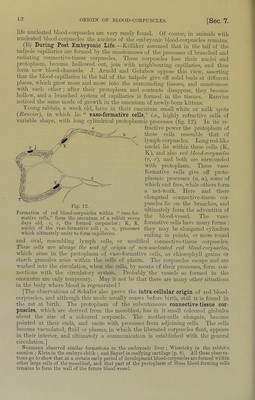
![brown or ^reen opalescent blood with colourless corpuscles (aiureboid cells). In cepbalopods and some ?rabs the blood is blue, owing to the presence ot a colouring matter (hsemocyanin), which contains copper, and combines with 0. Size (^i = 0'001 Millimetre) Of the Diso-shaped Corpuscles. Of the Elliptical Corpuscles. Short Dinmeter. Long Dinmeter. Elephant, . . 9T yu Man, . . . 7-7,, Dog, . . . 7’3,, Rabbit, . . 0'9,, Cat, . . . 0-.5„ Sheep, . . 5'0,, Goat, . . . 4’1,, Musk-deer,. . 2'5,, Llama, . • 4'0 ^ Dove, . . • 6'5 ,, Frog, . . . 15'7 ,, Triton, . ■ I9'5 ,, Proteus, . . 35'0 ,, The corpuscles of Amphiuu than those of Proteus {Riddel 8-0 yU 14-7 „ 22-3 „ 29-3 ,, 58-0 ,, la are nearly one-third larger )• 7. ORIGIN OF THE RED BLOOD-CORPUSCLES.—(A) During Embryonic I,ife,—Blood-corpuscles are developed in tlie fowl during the first days of em- bryonic life. [They appear in groups within the large branched cells of the inesohlast, in the vascular area of the blastoderm outside the developing Jody o the chick, Avhere they form the “blood-islands” of Pander. The mother-ceUs form an irregular network by the union of the processes^ of adjoining cells, and meantime the central masses split up, and the nuclei multiply. The smal nucleated masses of j^rotoplasm, Avhich reiDresent the blood-corpuscles, acquire a reddish hue, while the surroimding protoplasm, and also that of the processes, becomes vacuolated or hollowed out, constituting a branching system of canals, the outer part of the cells remainmg ivith their nuclei to form the walls of tlie future blood-vessels. A fluid appears withui this system of branched canals in which the coiqmscles lie, and gradually a commiuiication is estcahhshed ^ivitli the blood-vessels developed in connection with the heart. According to Ivlein, the nuclei of the protoplasmic wall also proliferate, and give rise to new cells, which are washed away to form blood-corpuscles.] At first the corpuscles exhibit amoeboid movements, are devoid of pigment, nucleated, globular, larger and more irregular than the permanent corpuscles. They become coloured, retani their nucleus, and are capable of undergoing multiplication by division j Remak observ'ed all the stages of the process of division, which is best seen from the 3rd to the 5th day of incubation. Increase by division also takes place hi the laryie of the salamander, triton, and toad {Flemming)-, and durmg the intra-uterhie hfe of a mammal, in the spleen, bone-niarroAV, the liver, and the circulating blood {Bkzozero). _ . . , Neumann found in the liver of the embryo protoplasmic cells contauiing reil lilood-corpuscles. Cells, some with, others without, hcenioglobin, but with large nuclei, have been found. These cells increase by diidsion, their nucleus shrivels, and they ultimately form hlood-corpuscles (Ldivit). The spleen is also regarded as a centre of their formation, but this seems to be the case only during embryonic life {Neumann). Here the red corpuscles are said to arise from yellow, round, nucleated cells, which represent transition forms. Foa and Salvioli found led corjmscles forming endogenously within large protoplasmic cells in lymphatic glands. In the later period of embryonic life the characteristic non-nucleated corjmscles seem to lie developed from the nucleated corpuscles. The nucleus becomes smaller and smaller, breaks up, and gradually disapj)ears. In the human embryo at the fourth week only nucleated corpuscles are found ; at the month their number is still of the total corjmscles, Avhile at the end of foetal](https://iiif.wellcomecollection.org/image/b21981516_0001_0051.jp2/full/800%2C/0/default.jpg)


 No text description is available for this image
 No text description is available for this image
 No text description is available for this image