Volume 1
A text-book of human physiology : including histology and microscopical anatomy : with special reference to the requirements of practical medicine / by L. Landois ; translated from the seventh German edition, with additions, by William Stirling.
- Date:
- 1891
Licence: Public Domain Mark
Credit: A text-book of human physiology : including histology and microscopical anatomy : with special reference to the requirements of practical medicine / by L. Landois ; translated from the seventh German edition, with additions, by William Stirling. Source: Wellcome Collection.
Provider: This material has been provided by the Royal College of Physicians of Edinburgh. The original may be consulted at the Royal College of Physicians of Edinburgh.
68/602 page 28
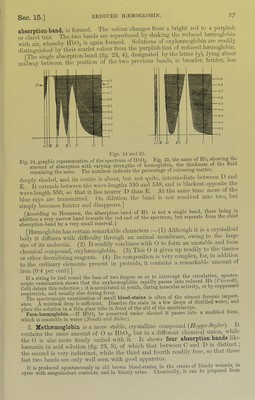
![a solution ot Hb by the action of potassic fen'icyanido {Jddcrholm) or potassic chlorate {Marcliand), [or by adding to a solution of Hb a fi^slily-prejiared solution of potassic permanga- nate, by nitro-benzol, azobenzol, kairin, sodium nitrite, pyrogallic acid]; and in ncn-laky blood by alloxantin {Kowalcwslcy). It crystallises if defibrinated blood is shaken with amyl nitrite and the mahogany-brown laky Iluid be allowed to evaporate slowly {Halliburton). If a trace of ammonia be added to a solution of methamioglobin, it gives an alkaline solution of methoemoglobin, which shows two bands like oxyhamioglobin, of which the first one is the broader, and extends more towards the red. If ammonium sulphide be added to the methanno- globin solution, reduced Hb is formed. [Action of Nitrites.—The addition of amyl nitrite dissolved in alcohol, or .sodic or potassic nitrite to defibrinated blood causes the latter to assume a chocolate colour, avhich, on the addition of ammonia, changes to red. The chocolate-coloured fluid shows one well-defined hand in tlie red, and less distinctly other three bands like metliEemoglobin {Gamgee).^ [The nitrites therefore form a compound with its oxygen more firmly fixed than the 0 in HbO„, so that large doses of nitrites arrest the internal respiration and are poisonous. It is, however, affected by the products formed in the blood during asphyxia, while CO-Hb is not’ the methsemoglobin formed by the nitrites is reduced by these products to Hb, which as it passes through the lungs takes up 0.] 16. CARBONIC OXIDE-HEMOGLOBIN, POISONING WITH CO.—3. CO- Hsemoglobin is a more stable chemical compound than the foregoing, and is pro- dirced at once Avhen carbonic oxide is brought into contact ndth pure Hb or HbO, {Cl. Bernard, 1857). It has an intensely florid or cherry-red colour, is not dichroic” and its spectrum shows two absorption-bands, very like those of IlbO^, but they are slightly closer together and lie more towards the violet (fig. 23, 3). Reducing substances which act upon Hb02, e.g., ammonium sulifliide or Stokes’s fluid, do not affect these bands, i.e., they cannot convert the CO-Hb into reduced Hb. If a 10 per cent, solution of caustic soda be added to a solution of CO-Hb, and heated, it gives a cmnabar-red colour; Avhile, with an HbOg solution, it gives a dark brown, greenish, greasy mass. Spectrum analysis and the soda test enable one to distinguish HbCO, mixed with Hb02- Oxidising substances [solutions of potassic permanganate (0'025 per cent.), potassic chlorate (5 per cent.), and dilute chlorine solution] make solutions of CO-Hb cherry-red in colour, while they turn solutions of HbO.2 pale yellow. After this treatment both solutions show tlie absorption-bands of methaemoglobin, but those of the CO-Hb appear consider- ably later. If ammoniimi sulphide be added, HlaOg and CO-Hb are re-formed. Hb-CO Reactions.—Modified SodaTest. —Dilute the blood 20 times and add an e(pial volume of caustic soda(S. 6. 1340) {Salkoicski). [Dilute 1 c.cm. HbCO with 50 c.cm. of water, to 10 c.cm. of this mixture add 02 c.cm. orange-coloured ammonmm suljihide (2 grms. of sulphur are added to 100 c.cm. yellow ammonium sulphide), and then 0'2 c.cm. of 30 per cent, acetic acid. The HbCO blood becomes bright red, while normal blood becomes greenish-gray {Katayama).'] On account of its stability, CO-Hb resists external influences and even putrefaction for a long time, and the two bands of the spectrum may be visible after many months. Landois olitained the soda test and spectroscopic bands in the blood of a woman poisoned eighteen months pre- viously by CO, and after great putrefaction of the body had taken place. [Stirling has kept CO-Hb in a stoppered bottle for five years without putrefaction taking place.] If CO or air containing it be inspired, it gradually displaces the 0, volume for volume, out of the red blood-corpuscles, and death soon occurs; 1000 c.cm. inspired at once Avill kiU a man. A very small quantity in the air - xirDTr) surtices, in a relatively short time, to form a large quantity of CO-Hb. As continued contact w’ith other gases (such as the passing of 0 through it for a very long time) gi-adually separates the CO from the Hb, with the formation of HhO,, it happens that, in very partial poisoning Avith CO, the blood gradually gets rid of the CO by the respiratory organs. It does not appear that any part is further oxidised into COg in tlie organism. [CO-hsemoglobin, being a stable compound wlien once formed, circulates in the blood-A^essels; but it neither gives iqi oxygen to the tissues, nor takes up oxygen in the lungs, hence its very poisonous properties.](https://iiif.wellcomecollection.org/image/b21981516_0001_0068.jp2/full/800%2C/0/default.jpg)
 No text description is available for this image
 No text description is available for this image
 No text description is available for this image