Volume 1
A text-book of human physiology : including histology and microscopical anatomy : with special reference to the requirements of practical medicine / by L. Landois ; translated from the seventh German edition, with additions, by William Stirling.
- Date:
- 1891
Licence: Public Domain Mark
Credit: A text-book of human physiology : including histology and microscopical anatomy : with special reference to the requirements of practical medicine / by L. Landois ; translated from the seventh German edition, with additions, by William Stirling. Source: Wellcome Collection.
Provider: This material has been provided by the Royal College of Physicians of Edinburgh. The original may be consulted at the Royal College of Physicians of Edinburgh.
74/602 page 34
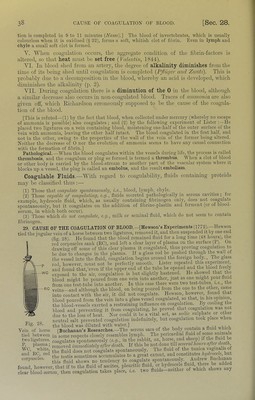
![fllirin. After this occui\s, the new fluid wliich reinaiii.s no longer coagulates spontaneously (it is plasma, minus the fibrin-factors), and is called blood-serum. Apart from the presence ojf the fibrin-factors, the chemical composition of plasma and serum is the same. '\^^len blood coagulates. Table I. shows what takes place, Avhile Table II. shows Avhat occurs when it is beaten :— I. II. Coagulation. Blood. Plasma. Coiimscles. I Serum. FlVirin-fnctors. Blood-Clot. WUen beaten. Blood. Plasma. Fibrin-factors. 1 Fibrin. Corpuscles Seram. Defibrinated Blood. Plasma is a clear, transparent, slightly thicldsh fluid, which, in most animals (rabbit, ox, cat, dog), is ahnost colourless; in man it is yeUoAV, and in the horse citron yellow. 26. PEEPARATION OF PLASMA.—(A) Without Admixture.—Takmg advantage of the fact that plasma, when cooled to 0° outside the body, does not coagidate for a considerable time, Briicke prepares the plasma thus:—The blood of the horse (because it coagidates slowly, and its corpuscles sinlc rapidly to the bottom) is received, as it flows from an artery, into a tall narrow glass, placed in a freezing-mixture, and cooled to 0°. The blood remains fluid, the coloured corpuscles subside in a few hoiu’S, while the plasma remains above as a clear layer, Avliicli can be removed with a cooled pipette. If this plasma be then passed through a cooled filter, it is robbed of all its colourless corpuscles. [Burdon- Sanderson uses a vessel consisting of three concentric compartments—the outer and inner contain ice, while the blood is caught in the central compartment, Avhicli does not exceed half an inch in diameter.] The quantity of plasma may be roughly (but only roughly) estimated by using a tall, graduated measm’ing-glass. If the plasma be Avarmed, it soon coagulates (oAving to the formation of the fibrin), and passes into a trembling jelly. If, however, it be beateii AAuth a glass rod, the fibrin is obtained as a Avhite stringy mass, adheruig to the rod. The quantity of fibrin in a given volume of plasma is very small (p. 35), although it Amries much in different cases. (B) With Admixture.—Blood floAving from an artery is caught in a taU vessel containing yth of its volume of a concentrated solution of sodic sulphate (Hewson) or in a 25 per cent, solution of magnesic sidphate (1 vol. to 4 vols. blood Simmer)—or 1 vol. blood Avith 2 vols. of a 4 per cent, solution of monophosphate of potash {Masia). When the blood is mixed with these fluids and put in a cool place, the corpuscles subside, and the clear stratum of plasma mixed Avith the salts may be removed Avith a pipette. [The plasma so obtained is called “salted plasma.”] If the salts be removed by dialysis, coagulation occurs; or it may be caused by the addition of Avater [Joh. Muller). Blood Avliich is mixed Avith a 4 per cent, solution of common salt does not coagulate, so that it also may be used for the preparation of plasma. [For frog’s blood Johannes Muller used a | per cent, solution of cane-sugar, Avhich permits the corpuscles to be separated from the plasma by filtration. The plasma mixed with the sugar coagulates in a short time.] 27. COAGULATION OF THE BLOOD.—FIBRIN.—[Blood within the living body is fluid, and Avhen first shed it remains so for a short time. After](https://iiif.wellcomecollection.org/image/b21981516_0001_0074.jp2/full/800%2C/0/default.jpg)

 No text description is available for this image
 No text description is available for this image
 No text description is available for this image