Volume 1
A text-book of human physiology : including histology and microscopical anatomy : with special reference to the requirements of practical medicine / by L. Landois ; translated from the seventh German edition, with additions, by William Stirling.
- Date:
- 1891
Licence: Public Domain Mark
Credit: A text-book of human physiology : including histology and microscopical anatomy : with special reference to the requirements of practical medicine / by L. Landois ; translated from the seventh German edition, with additions, by William Stirling. Source: Wellcome Collection.
Provider: This material has been provided by the Royal College of Physicians of Edinburgh. The original may be consulted at the Royal College of Physicians of Edinburgh.
78/602 page 38
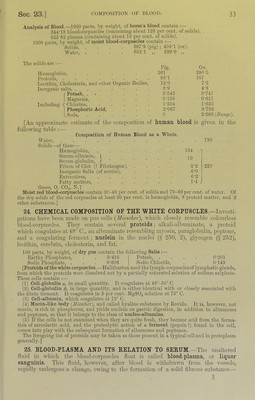
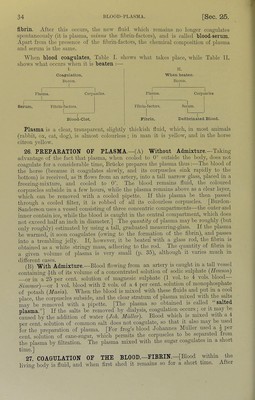
![tiou is comiileted in 9 to 11 minutes (N'assc).] The blood of invertebrates, which is u-sually colourless when it is oxidised (§ 32), forms a soft, whitish clot of fibrin. Even in lymph and chyle a small soft clot is formed. AVlien coagulation occurs, tlie aggregate condition of the fihrin-factor.s is altered, so that heat must he set free [Valentin, 1844). A^I. In blood shed from an artery, the degree of alkalinity diminishes from the time of its being shed until coagulation is completed {Pfliicjer and Zuntz). This is probablj^ due to a decomposition in the blood, wdiereby an acid is det^eloped, Avhich dimmishes the alkalinity (p. 2). A^II. During coagulation there is a diminution of the 0 in the blood, although a similar decrease also occurs in non-coagulated blood. Traces of ammonia are also given off, -which Eichardson erroneously supposed to be the cause of the coagula- tion of the blood. [This is refuted—(1) by the fact that blood, when collected under mercury (whereby no escape of ammonia is po.ssible) also coagulates ; and (2) by the following experiment of Lister :—He placed two ligatures on a vein containing blood, moistening one-half of the outer surface of the vein with ammonia, leaving the other half intact. The blood coagulated in the first half, and not in the other, owing to the properties of the wall of the vein of the former being altered. Neither the decrease of 0 nor the evolution of ammonia seems to have any causal connection witli the formation of fibrin.] Pathological.—When the blood coagulates within the vessels during life, the process is called thrombosis, and the coagulum or plug so formed is termed a thrombus. When a clot of blood or other body is carried by the blood-stream to another part of the vascular system where it blocks up a vessel, the plug is called an embolus, and the result embolism. Coagulable Fluids.—ATith regard to coagulability, fluids containmg proteids may be classified thus ;— (1) Those that coagulate spontaneously, i.e., blood, lympb, chyle. (2) Those capahle of coagulating, c.g., fluids secreted pathologically in serous cavities; for example, hydrocele fluid, which, as usually containing fibrinogen only, does not coagulate spontaneously, but it coagulates on the addition of fibrino-plastin and ferment (or of blood- serum, in which both occur). . (3) Those which do not coagulate, e.g., milk or seminal fluid, which do not seem to contain fibrinogen. 29. CAUSE OF THE COAGULATION OF BLOOD.—[Hewson’sExperiments(1772).—Hewson i-iarl flip incmla.r vpin nf a lirtrsp. hfitweeii two liffaturcs, I'emoved it, aiid then suspended it by one end](https://iiif.wellcomecollection.org/image/b21981516_0001_0078.jp2/full/800%2C/0/default.jpg)

 No text description is available for this image
 No text description is available for this image
 No text description is available for this image