Volume 1
A text-book of human physiology : including histology and microscopical anatomy : with special reference to the requirements of practical medicine / by L. Landois ; translated from the seventh German edition, with additions, by William Stirling.
- Date:
- 1891
Licence: Public Domain Mark
Credit: A text-book of human physiology : including histology and microscopical anatomy : with special reference to the requirements of practical medicine / by L. Landois ; translated from the seventh German edition, with additions, by William Stirling. Source: Wellcome Collection.
Provider: This material has been provided by the Royal College of Physicians of Edinburgh. The original may be consulted at the Royal College of Physicians of Edinburgh.
79/602 page 39
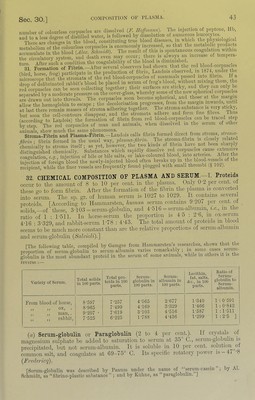
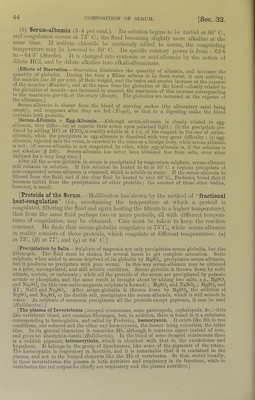
![tendency hij itself to coagulate—form a clot when they are mi.'ced (1831). if “washed blood-clot” (which consists of a mixture of fil He also found tliat fibrin and colourless corpuscles) be added to hydrocele fluid, coagulation occurred. He compared the action of washed blood-clot to the action of rennet in coagulating milk, and he imagined the agents which determined the coagulation to be colourless corpuscles. Thus, the bully coat of horses blood is a poweiful agent, and it contains numerous colourless corpuscles. He linally concluded that some constituent in the plasma, to which he gave the name of a “soluble fibrin,” is acted upon by the colourless corpuscles ’and converted into fibrin. The soluble fibrin of Buchanan is comparable to the fibrinoen in Hammarsten’s theory. Buchanan, however, did not separate the substance.] [Dems’s Plasmine (1859).—Denis mixed uncoagulated blood with a saturated solution of sodic sulphate, and allowed the corpuscles to subside. The salted plasma thus obtained he pre- ciintated with sodic chloride. The precipitate, when washed with a saturated solution of sodic chloride, he called plasmine. If plasmine be mixed with water, it coagulates spontaneously, resulting in the formation of fibrin, while another proteid remains in solution. According to the view of Denis, fibrin is produced by the splitting up of plasmine into two bodies—fibrin and a .soluble proteid.] , , ^ , [If to plasma, e.g., from horse’s blood, there be added NaCl to the extent of 13 per cent., a white viscid precipitate is thrown down. If this precipitate be removed, and more NaCl added, or MgSO^ crystals, another proteid, white and granular, is precipitated. The former is fibrinogen, and the latter para-globnlin, so that the so-called plasmine of Denis really consists of two proteids; only the former, however, is converted into fibrin.] [Briicke’s experiments were directed to tlie question why the blood does not coagulate within the vessels. Hewson had shown that blood remains fluid for 6-14 hours in the vessels after the death of the animal (dog). In the case of cold-blooded animals, e.g., the turtle at-1-1° C, the blood remained fluid for six to eight days. Again, the blood remained fluid in the excised heart of a turtle kept moist under a bell jar as long as the heart continued to beat and until the cardiac walls lost their excitability. A foreign body introduced into the blood-vessels was soon surrounded with a clot of fibrin, which was always deposited on the foreign body itself and_ not on the walls of the blood-vessels. The same results were obtained in mammals, and especially in new-born animals. This action of the vascular wall in preventing coagulation only exists as long as the wall itself is intact and alive.] [Lister maintained that the blood has no spontaneous tendency to clot, as Briicke supposed, but that it only clots when brought into contact with foreign matter, and this is the view now generally held.] [A. Schmidt’s Researches (1861).—This observer rediscovered the chief facts already knowm to'Buchanan, viz., that some fluids which do not coagulate spontaneously clot when mixed with other fluids, which show no tendency to coagulate spontaneously, e.g., hydrocele fluid and blood-serum. He isolated from these fluids the bodies described as fibrinogen and fibrino- plastin. The bodies so obtained were not pure, bvrt Schmidt supposed that the formation of fibrin was due to the interaction of these two proteids. The reason hydrocele fluid does not coagulate, he says, is that it contains fibrinogen and no fibrino-plastin, while blood-serum con- tains the latter, but not the former. Schmidt afterwards discovered that these two substances may be present in a fluid, and yet coagulation may not occur {e.g., occasionally in hydrocele fluid). He supposed, therefore, that blood or blood-serum contained some other constituent necessary for coagulation. This he afterwards isolated in an impure condition and called fibrin-ferment.'] A. Schmidt’s theory of Coagulation is that fibrin is formed by the coming together of two proteid substances wdiich occur dissolved in the plasma, viz.:—(1) fibrinogen, i.e., the substance which yields the chief mass of the fibrin, and (2) fibrino-plastic substance or fibrino-plastin. The latter terms are noiv rarely used, having been replaced by either of the following—serum-globuUn or para-globulin, § .32. In order to determine the coagulation a ferment seems to be necessary, and this is supplied by (3) the fibrin-ferment. [Reviewing all the evidence, it seems quite certain that para-globulin is not concerned in the process of coagulation, so that Schmidt’s theory has now given idace to that of Hammarsten (p 41).] 1. Properties of Fibrinogen and fibrino-plastin.—They belong to the group of proteids called globulins, i.e., they are insoluble in inire Avater, but are soluble in dilute saline solutions (e.r/., common salt, § 249), and are not distinguished from each other by well-marke(l chemical characters. Still they differ as folloAvs:— Fibrino-piastin or Serum-globulin is more easily precipitated from its solutions than fibrinogen. It is more readily redissolved Avhen once it is precipitated. It forms Avhen preeijiitated a very light granular powder, [and its saline solution coagulates at 75 C.].](https://iiif.wellcomecollection.org/image/b21981516_0001_0079.jp2/full/800%2C/0/default.jpg)
 No text description is available for this image
 No text description is available for this image
 No text description is available for this image