Volume 1
A text-book of human physiology : including histology and microscopical anatomy : with special reference to the requirements of practical medicine / by L. Landois ; translated from the seventh German edition, with additions, by William Stirling.
- Date:
- 1891
Licence: Public Domain Mark
Credit: A text-book of human physiology : including histology and microscopical anatomy : with special reference to the requirements of practical medicine / by L. Landois ; translated from the seventh German edition, with additions, by William Stirling. Source: Wellcome Collection.
Provider: This material has been provided by the Royal College of Physicians of Edinburgh. The original may be consulted at the Royal College of Physicians of Edinburgh.
88/602 page 48
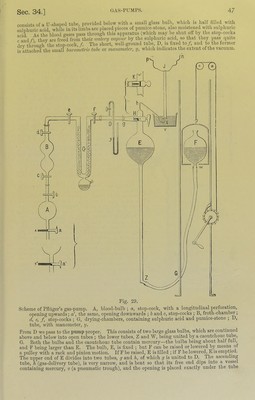
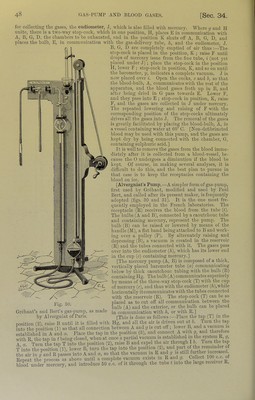
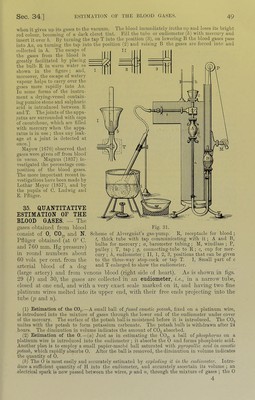
![for collectiug the gases, the eudiometer, J, -which is also filled with mercury. Wliere </ and II unite, there is a two-way stop-cock, which in one position, H, places E in communication with A, B, G, D, the chambers to be exhausted, and in the jiosition K shuts olf A, B, G, D, and places the bulb, E, in communication with the gas-delivery tube, h, and the eudiometer, J. B, G, l3 are completely emptied of air thus :—The stop-cock is placed in the position, K ; raise F until drops of mercury issue from the fine tube, i (not yet placed under J) ; place the stop-cock in the position H, lower F : stop-cock in position, K, and so on until the barometer, y, indicates a com]ilctc vacuum. J is now placed over i. Open the cocks, c and h, so that the blood-bulb. A, communicates with the rest of tlie apparatus, and the blood gases froth up in B, and after being dried in G pass towards E. Lower F, and they pass into E ; stop-cock in position, K, raise F, and the gases are collected in J under mercury. The repeated lowering and raising of F with the corresponding position of the stop-cocks ultimately drives all the gases into J. The removal of the gases is greatly facilitated by placing the blood-bulb. A, in a vessel containing water at 60° C. [Non-defibrimited blood may be used with this pump, and the gases are kept dry by being connected with the chamber, G, containing sulphuric acid.] It is well to remove the gases from the blood imme- 1 diately after it is collected from a blood-vessel, be- I iHk the 0 undergoes a diminution if the blood be 1 III kept. Of course, in making several analyses, it is difficult to do this, and the best plan to pursue in that case is to keep the receptacles containing the blood on ice. [Alvergniat’s Pump.—A simpler form of gas-pump, first used by Grehant, modified and used by Paul Bert, and called after its present maker, is frequently adopted (figs. 30 and 31). It is the one most fre- quently employed in the French laboratories. The receptacle (R) receives the blood from the tube it). The bulbs (A and B), connected by a caoutchouc tube and containing mercury, represent the pump. The bulb (B) can be raised or lowered by means of the handle (M), a flat band being attached to B and work- ing over a pulley (P). By alternately raising and depressing (B), a vacuum is created in the reservoir (R) and the tubes connected with it. The gases pass over into the eudiometer (7i), which has its lower end in the cup (c) containing mercury.] [The mercury pump (A, B) is composed of a thick, vertically placed barometer tube (a) communicating below by thick caoutchouc tubing with the bulb (B) containing Hg. The bulb (A) communicates superiorly by means of the three-way stop-cock (T) with the cup of mercury (c), and thus with the eudiometer (A),while horizontally itcommuuicates with the tubes connected with the reservoir (R). The stop-cock (T) can be so placed as to cut off all communication between the bulb (A) and the exterior, or the bulb can be placed in communication with /t, or with R.] [This is done as follows Place the tap (T) in the , i_.; q’uni the tap /v Fig. 30. Grehaut’s and Bert’s gas-pump, as made by Alvergniat of Paris. position (2), raise B until it is filled with Hg, and all the air is driven out fit *• into the position (1) so that all connection between A and cj is cut oft ; lower B, and a vacuuin is established in A and a. Place the tap in the position (3), and connect A with g and therefore with R, the tap in t being closed, when at once a partial vacuuin is established in the system R^ ■ ■ ■’ ra se P, and exnel the air through I 6. lurnthetap A a. Turn the tap T into the position (2), raise B and expel the air through I 6. '1 urn the tap T’into the position (1), lower B, turn the tap into the position (2), the air in g and R passes into A and a, so that the vacuum in R and g is stdl flirty l oo c c of Repeat the process as above until a complete vacuum exists in R aiul y. Collect lOO c.c. ot blood under^mercuiy, and introduce 50 c!c. of it through the tube «into the large receiver R,](https://iiif.wellcomecollection.org/image/b21981516_0001_0088.jp2/full/800%2C/0/default.jpg)
 No text description is available for this image
 No text description is available for this image
 No text description is available for this image