Cellular pathology : as based upon physiological and pathological histology; twenty lectures delivered in the Pathological Institute of Berlin during the months of February, March, and April, 1858 / by Rudolf Virchow; translated from the second edition of the original by Frank Chance; with notes and numerous emendations, principally from ms. notes of the author.
- Rudolf Virchow
- Date:
- MDCCCLX. [1860]
Licence: Public Domain Mark
Credit: Cellular pathology : as based upon physiological and pathological histology; twenty lectures delivered in the Pathological Institute of Berlin during the months of February, March, and April, 1858 / by Rudolf Virchow; translated from the second edition of the original by Frank Chance; with notes and numerous emendations, principally from ms. notes of the author. Source: Wellcome Collection.
Provider: This material has been provided by King’s College London. The original may be consulted at King’s College London.
529/546 (page 499)
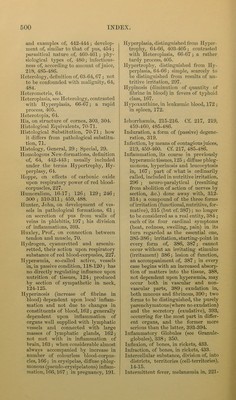
![spinal cord, 2G1; on disposition of nerves in cortex of cerebellum, 269. Gland-cells, essential elements of glands, -10; locomotory effect produced by,291. Glands, active elements of, essentially of epithelial nature, 39; development of (sudoriferous, sebaceous, mammary, stomach-, liver), 39-40; uni-cellular, 40; object of transuded fluid in, 41; lymphatic, 50, 172-176; lym- phoid, 192-194; salivary, Ludwig’s researches on, 291. Globes epidermiques, 483, 485. Globules, elementary, false notions respecting, 25; laminated, see Epi- dermic globules. Globules, inflammatory. See Inflamma- tory globules. Gluge, his inflammatory globules, 338. Gobley, on lecithine (myeline), 234. Goodsir, Prof., on nuclei, 310. Gout, metastatic deposits in, 213- 214. Graefe, 212, 301; on parenchymatous keratitis, 306. Granulation of bone, 421. liranulations, close correspondence be- tween, and medullary tissue, 421 ; transformation of, into pus, 421-422; starting-point of all heteroplastic development, 426; formation of, in suppuration of connective tissue, 452. Granide- (Fat-granule-) Cells, 336-337; diagnosis between, and pigment-ceUs, 346, 347. Granule Globules [exudation - corpus- cles], 338-339, 350 ; in atheromatous deposits, 357. Granules, elementary, 20. Growth, connection between, and de- structive, heteroplastic processes, 453- 454. Giiterbock, on pus-corpuscles, 149. Ilseraatine, 139; three kinds of crystals derived from, 142; hajmatoidine, 142-145; hsemine, 145-146; hsemato- crystalline, 146-148. IlEemato-crystalline, 146-148; very perishable, 147, affected by oxygen and carbonic acid in same way as ha3matine, 147. Ha:matoidine, 142-145; spontaneously fonned from h®matine, 142; crystals extremely minute, 143; formation of, in apoplectic clots and Graafian vesicles, 143-144; allied to colouring matter of bile, 144. llarniaturia, from papillary tumours of bladder, 468, Ha;minc, 145-146; not a spontaneous j)roduct, 145; of great importance in forensic medicine, 145-146. Hacmitis, Piorry’s doctrine of, 155, 189. Haemorrhage, cannot occur by transu- dation (per diapedesin) without rui)- ture, 113. Hffimorrhagic diathesis, its origin often to be sought for in spleen or liver, 132; in leukajmia, 169. Hair, in brain, 66. Hair-foUicle, with sebaceous glands, 335. Haller, importance assigned to fibres by, 25; on irritability, 294; on ossi- fication of vessels, 354; on atheroma, 356. Hannover, on epitheliomata, 482. Haptogenic Membrane, 337. Harting, G., on vesicles found as artifi- cial products in blood, 224; on secre- tion of liver after section of its nerves, 293. Havers, on development of long bones, 407, 408, 409. Haversian canals, 79-81; their connec- tion with bone-corpuscles, 85-86. Heart, so-called purulent cysts of, 203- 204; inflammation of valves of, 208, 363, 364; fatty degeneration of, two kinds, 325, from excessive dilatation of its cavities, 352-353, of valves of) 362, 363. Heerd, definition of, 341; cf. 457. Heidenhain, Junr., on epithelium of intestinal viUi, 327. Henle, on transitional epithelium, 32; his theory of the formation of con- nective tissue, 42-44; on lining mem- brane of cerebral ventricles, 273; on development of mucus- and pus-corpus- cles on mucous membranes, 405,406. Hepatic Artery, supplies branches to capillary network of acini of liver, 75; amyloid degeneration of terminal ra- mifications of, 375. Hepatic Cells, arrangement of, and re- lation to capillaries of liver, 74; really active elements of liver, 127; absorption of fat by, 128; forma- tion of sugar by, 128 ; accuimdation of fat in (fatty degeneration), 332; amyloid degeneration of, 375-376. Hepatitis, no fibrine found in genuine, 390. Heteradenia, 61. Heterochronia, 64. Heterologous New-formations, not ne- cessarily malignant,61,484; developed with great rapidity, 405; granulations the starting-point of, 426 ; definition](https://iiif.wellcomecollection.org/image/b21308986_0529.jp2/full/800%2C/0/default.jpg)