Cellular pathology : as based upon physiological and pathological histology; twenty lectures delivered in the Pathological Institute of Berlin during the months of February, March, and April, 1858 / by Rudolf Virchow; translated from the second edition of the original by Frank Chance; with notes and numerous emendations, principally from ms. notes of the author.
- Rudolf Virchow
- Date:
- MDCCCLX. [1860]
Licence: Public Domain Mark
Credit: Cellular pathology : as based upon physiological and pathological histology; twenty lectures delivered in the Pathological Institute of Berlin during the months of February, March, and April, 1858 / by Rudolf Virchow; translated from the second edition of the original by Frank Chance; with notes and numerous emendations, principally from ms. notes of the author. Source: Wellcome Collection.
Provider: This material has been provided by King’s College London. The original may be consulted at King’s College London.
534/546 (page 504)
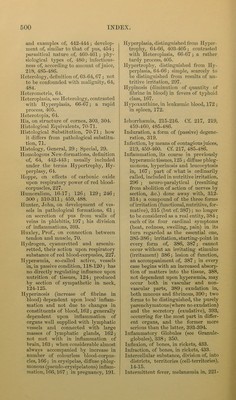
![cuimective tissue, 101; first observer of tlie large, ])ale nerve-fibres seen in spinal cord of Petromyzon fluvia- tilis, 271; on correspondence between embryonic and patliological develop- ment, 399 ; on collonema, 480 ; on cholesteatoma, 482. Mummies, preservation of tissues in, 287. Muscle: seldom found in new-forma- tions, 63; irritability of, 294. Striated (red), 51-54; transverse and longitudinal strise of, 51; nuclei of, 51-52; origin of primitive fasci- culi of, 52; contractility of contents, 53, 56-57, tbeir structure, 54; pro- gressive (fatty) atrophy of, 56; hy- pertrophy of, 65; substitution of, for smooth, 71; changes produced in ultimate elements of) by excitation (irritation), 290; division of nuclei of, from irritation, 308-309, in em- bryonic development, 309; softening of) 318-319; interstitial so-caUed fatty degeneration, or rather fattening of, 323-325; parenchymatous fatty degeneration of, simple, 342-344, in- flammatory (secondary) 352; suppu- ration in interstitial tissue of, 445. Smooth (organic, involuntary), 54-56 ; fascicular arrangement of, 55; comparison between fibre-ceUs of, and primitive fasciculi of striated muscle, 55 ; nuclei of, 12, 55; of skin (arrectorespUorum) 57; contraction of vessels, due to, 57; substitution of striped for, 71; of dartos, 107; of arteries, 110-111; in alse vesperti- tionum, 115-116; new formation of, in fibrous tumours of uterus, 443. Myeline, 234-236. Myeloid Tumours, 308. Myo-carditis, no fibrine set free in, 390, cf. 352-353. Myo-malacia, 318-319. Myxomata, 480, 486. Niigeli, on corpora amylacea, 282. Nails, body of, composed of cells, 34', 37; structure of, 35-36; growth of, 36; diseases of, 37-38. Navel, varieties of, bow produced, 96. Necrobiosis, definition of, 318; how distinguished from necrosis, 318; ends in softening and disintegration, 318-319. Necrosis, distinction between, and ne- crobiosis, 318; of bone, limits of territories of bone-cells weU shown in, 418-419. Neophisms. See Ncw-Formations. Nejdiritis, jjarenchymatous and inter- stitial, 381. Nerve-cells. See Ganglion-cells. Nerve-fibres, primitive, their mem- brane, medullary slieath, and axis-cy- linder, 231; wliite and grey, distinc- tion between, 232; myeline of, 234- 236; grey atrophy of, 235; axis- cylinder (electrical substance) essen- tial constituent of, 236; different breadth of) 236-237; terminations of, 238-255—in Pacinian bodies, 238-240—in tactile bodies, 240- 242—in loops, nowhere met with, 247, cf. 238, 242—supposed, in epi- thelium-like structures (in mucous membrane of nose and tongue) 247- 248 — in cochlea, 248 — in retina, 248-252—in plexuses (electrical organ of silurus, 253, and submucous tissue of intestines (human) 254-255) ; rami- fication of, 252-253; course and origin of, in spinal cord, 267-268. Nerve-territories, in skin larger than vessel-territories, 244. Nerves, seldom found in new-formations, 63; peripheral, structure of, 230; fascicular arrangement of, 230; in- terstitial tissue of, 230, 279-280; grey atrophy of, 235; terminations of, 238-255; of special sense (olfac- tory, auditory, optic) 247—252; elec- trical processes constantly going on in, 287 ; changes in electrical state of, produced by excitation (irritation) 290. Nervous Centres, 257-282; colour of grey matter of, not due to ganglion- ceUs, 257; different kinds of gang- lion-cells in, 258-262; interstitial substance of (neuro-glia) not nervous but a kind of connective tissue, 272- 273 ; corpora amylacea of, 279-282 ; made up of an infinite number of separate,very minute centres, 284-285. Nervous Plexuses, in Silurus, 253, 263 ; in submucous tissue of intestines, 254-255. Nervous System, 58 ; 229-282 ; its pre- tended unity, 229, 284-285 ; its com- position, 228-229; fibrous constituents of, 229-256; nervous centres (gan- glionic apparatuses), 256-282. Neurilemma, 230; its relation to peri- neurium, 280. Neuro-glia, 275 ; 277-280 (see 272-273); definition of, 277 ; a kind of soft connective tissue with corpuscles, 277-278, cf. 275; also found in olfactory and auditory nerves, 279. Neuro-Pathology. See Solidism.](https://iiif.wellcomecollection.org/image/b21308986_0534.jp2/full/800%2C/0/default.jpg)